Shade 3Navy1627–1956
Brussels, Wilton and Kidderminster: woven carpet before tufting
From the 1730s British looms wove carpet for buyers who could not afford knotted pile, and the woven industry that grew from them in Britain and America was the one tufted carpet later undercut.

Key dates
On 30 May 1800 the London auctioneer James Christie offered 150 lots of carpet in one sale. His eight-page catalogue named four kinds: Brussels, Wilton, Venetian and Kidderminster, all of them woven on the loom. A microfilm of it is at the New York Public Library and has not yet been seen for this book.11James Christie (1730–1803), Christie’s sale catalogue of 150 lots of Brussels, Wilton, Venetian and Kidderminster carpets, 30 May 1800, 1800, New York Public Library (microfilm), *ZM MAY p.v. 1, no. 18; OCLC 44515494. Record This chapter follows those carpets from their beginnings to the industry that tufting displaced.
Knotted carpet, the costly standard
The model was French and knotted by hand. Pierre Dupont is said to have set up a workshop in a former soap factory at Chaillot around 1615, and in 1627 Louis XIII granted him and his former apprentice Simon Lourdet an eighteen-year monopoly on carpets “in the Turkish manner”.22“Savonnerie, Paris: Dupont’s workshop (1615) and the 1627 royal monopoly with Lourdet for knotted 'Turkish-manner' carpets”, 1615; 1627, research note. Record The Metropolitan Museum’s carpet of 1680, after designs by Charles Le Brun, is one of the series woven for the Grande Galerie of the Louvre: knotted wool pile, 896.6 by 325.1 centimetres. By Sotheby’s count Dupont’s workshop made 32 of the series and the Lourdet workshops 60.33Grande Galerie carpet with landscapes (Savonnerie, after Charles Le Brun), 1680, 1680, The Metropolitan Museum of Art, 1976.155.114. Record

In the 1750s Savonnerie weavers came to London. Peter Parisot employed workers from Chaillot, first at Paddington and then at Fulham, with money from the Duke of Cumberland. The Victoria County History records that his goods were judged too costly, and his stock was auctioned in January 1756; the venture’s start is dated 1750 in one account and 1753 in another.44“Peter Parisot’s Fulham carpet manufactory (1750/1753–55): Savonnerie weavers in London”, 1750 or 1753–1755, research note. Record Claude Passavant, a Swiss Huguenot, moved the weavers to Exeter, where, according to Axminster Heritage, the works stopped trading in 1761 because its carpets were too expensive.55“Claude Passavant’s Exeter carpet manufactory (1756–1761): costly knotted carpets, three survivors”, 1756–1761, research note. Record
Thomas Whitty, who had run a cloth business since 1737, finished his first knotted carpet at Axminster at midsummer 1755.66“Thomas Whitty finishes his first hand-knotted carpet at Axminster on Midsummer Day 1755”, 1755, research note. Record The Society of Arts then offered prizes for English “Turkey” carpets. In 1757 Thomas Moore of Moorfields made the finest carpet, but at forty guineas; Whitty’s, at £15, was judged the best value, and the prize was split. Whitty won outright in 1759.77“Society of Arts carpet premiums, 1757–59: Moore and Whitty share 1757; Whitty wins outright in 1759”, 1757–1759. Record Moore also wove to Robert Adam’s designs: the Soane Museum describes the drawing-room carpet at Osterley as “executed in accordance with Adam’s design by Thomas Moore of Moorfields”.88“Thomas Moore’s Moorfields manufactory: knotted carpets for Robert Adam (Osterley)”, c. 1757–1770s, research note. Record
In 2025 the Met acquired a knotted wool carpet attributed to Whitty and dated about 1765. The museum gives his dates as 1713 to 1792, though other accounts give 1716 for his birth.99Axminster carpet attributed to Thomas Whitty, ca. 1765 (Met 2025.725), ca. 1765, The Metropolitan Museum of Art, 2025.725. Record “Thomas Whitty finishes his first hand-knotted carpet at Axminster on Midsummer Day 1755”, 1755, research note. Record Its other Whitty carpet, “probably” his, dates from about 1780 to 1790.1010Axminster carpet, probably Thomas Whitty, c. 1780–90, ca. 1780–90, The Metropolitan Museum of Art, 57.162a, b. Record
Flat carpet: Kidderminster, Scotch and Venetian
Below the knotted carpet sat a flat one. In 1735, the 1911 Encyclopaedia Britannica says, Kidderminster’s woollen trade “was however replaced by that of carpets”, and at first the town made only “Kidderminster” carpets. Local historians credit John Pearsall with the first, or else two stuff weavers. By 1772, according to the 1797 Britannica, the town had over 250 carpet looms.1111“Kidderminster begins weaving flat, double-cloth 'Kidderminster' (ingrain) carpet in 1735”, 1735, research note. Record The cloth was double: a mid-nineteenth-century sample at the Victoria and Albert Museum has a worsted warp and a woollen weft, “a construction particular to this type of carpet”, and the 1842 Britannica describes it as “composed of two plies of cloth”, the colours reversed on the back.1212Sample of Kidderminster carpeting, double cloth (Dove & Co., Leeds, mid-19th century), mid-19th century, Victoria and Albert Museum, T.5-1959. Record
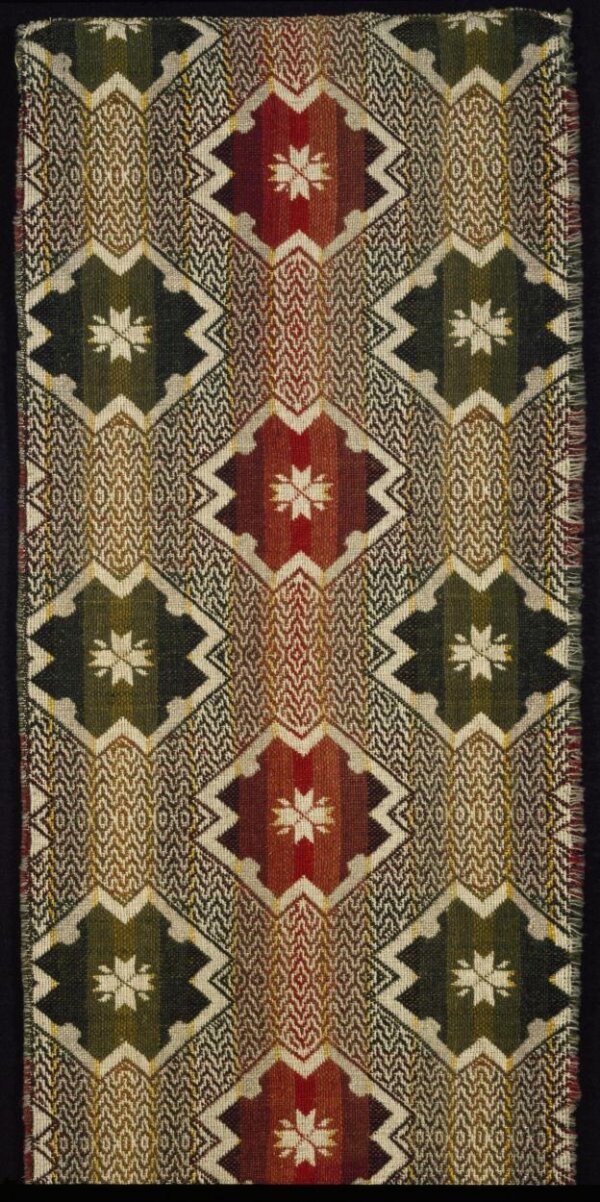
The same cloth had other names. One local history says it was called ingrain, then Kidderminster, then Scotch once the process moved to Scotland.1313“Kidderminster begins weaving flat, double-cloth 'Kidderminster' (ingrain) carpet in 1735”, 1735, research note. Record A single source dates carpet-making at Kilmarnock to 1728; it has not been confirmed elsewhere. A museum account describes Kilmarnock’s early Scotch carpets as pileless cloth rugs, sold largely to Holland.1414“'Scotch' carpet in Kilmarnock (from 1728?): pileless double cloth, much of it sold to Holland”, 1728 (single source), research note. Record
Vanessa Habib has used Thomas Gilfillan’s cash book and ledger of 1764 to 1770 as rare evidence of a working Scotch carpet manufactory at Stirling. She quotes an observer of 1776 on whom they suited:1515Vanessa Habib, “Scotch carpets at Stirling: Thomas Gilfillan’s cash book and ledger, 1764–1770 (and Axminster manufacture in Edinburgh)”, 2000; 2005. Record
cannot afford the extravagant prices of Wilton, Axminster, and other more expensive manufactories
An observer of 1776, quoted by Vanessa HabibVenetian carpet was the other flat kind. The 1842 Britannica says it was used mostly for stairs, passages and lobbies, the plain sorts usually striped in colours shading from dark to light.1616“Venetian carpet: striped, worsted-warp flat carpet for stairs and passages”, 17th–19th century, research note. Record
Pile on the loom: Brussels and Wilton
Brussels carpet raised its pile on the loom. In the 1842 Britannica’s account, long steel wires were inserted between the linen and worsted warps, looping up the worsted pile; Brussels and Wilton were woven “in looms of the same construction”.1717“Brussels carpet: looped wool pile raised over steel wires on the loom”, by the 1740s, research note. Record The National Park Service adds that Brussels was woven in strips on a 27-inch loom. Wilton was the same carpet with the loops cut, giving a velvet surface: its wires had a groove along which a knife, the “travat”, was run.1818“Brussels carpet: looped wool pile raised over steel wires on the loom”, by the 1740s, research note. Record “How cutting the loops made Wilton: the bladed or grooved wire and the 'travat' knife”, 18th century (exact date disputed), research note. Record
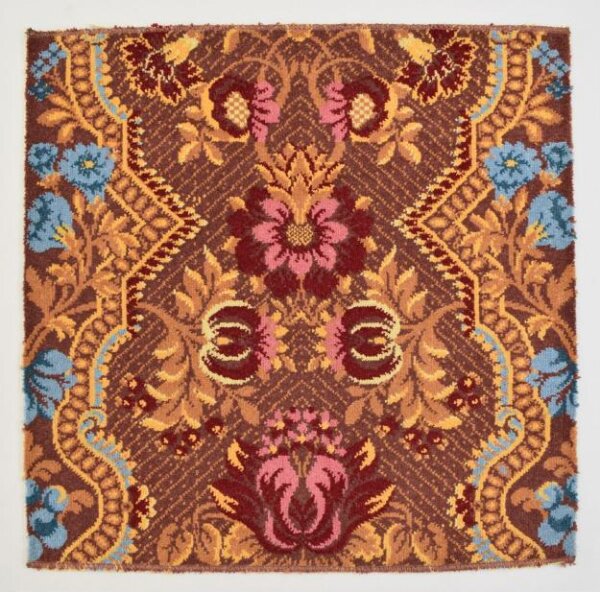
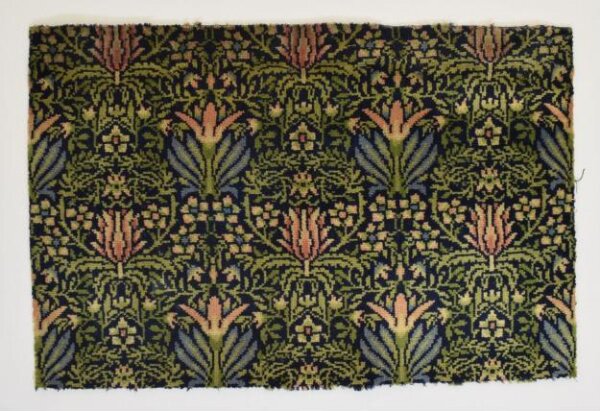
When the loops were first cut at Wilton is disputed. The charter that Wilton’s weavers sought in 1699 concerned the woollen-cloth trade, not carpet.1919“1699: Wilton’s clothiers and weavers seek a charter to restrict the weaving trade (cloth, not yet carpet)”, 1699, research note. Record All accounts credit the 9th Earl of Pembroke with bringing French weavers to Wilton, smuggled in wine barrels in one legend; the town’s heritage trail says 1741, the firm Wilton Carpets 1721.2020“The Earl of Pembroke’s French weavers at Wilton: 1721 or 1741? (and the 'wine cask' story)”, 1721 or 1741 (conflict), research note. Record The Victoria County History gives the first written evidence of carpet at Wilton as a patent of 1741 to Ignatius Couran, John Barford and William Moody for carpeting “known as Moccadoes”. It notes that the patented loom had no device for cutting the loops, and points to French moquettes as their likelier origin. The firm credits a weaver it calls Defosse with the cutting.2121“1741 patent to Couran, Barford and Moody for carpet 'Moccadoes', the first written evidence of Wilton carpet”, 1741, research note. Record “Wilton: Huguenot weavers (1720s) and the first Wilton loom (1741)”, 1720s–1741, research note. Record The first known use of “Wilton” for the carpet is dated 1774.2222“How cutting the loops made Wilton: the bladed or grooved wire and the 'travat' knife”, 18th century (exact date disputed), research note. Record
Kidderminster set up a Brussels loom in 1749.2323“1749: Brussels looms reach Kidderminster (John Broom and John Pearsall) and the town makes carpets 'the same as Wilton'”, 1749, research note. Record Tradition says John Broom “travelled to Brussels, Tournai, or Wilton” and came back with the plans and the workers; the local-history site that tells it warns that none of the versions can be proved and all suggest industrial espionage. One account has Broom and Pearsall putting up a building with 32 looms at Mount Skippet that March. The two towns became rivals.2424“1749: Brussels looms reach Kidderminster (John Broom and John Pearsall) and the town makes carpets 'the same as Wilton'”, 1749, research note. Record “1741 patent to Couran, Barford and Moody for carpet 'Moccadoes', the first written evidence of Wilton carpet”, 1741, research note. Record
American floors
America imported first. The National Park Service finds Brussels and Wilton in American inventories and advertisements from the 1750s.2525“Brussels and Wilton carpet reached America in the 1750s; Americans favoured Wilton”, 1750s, research note. Record But it also says that by the last quarter of the century most middle-class houses had inexpensive Scotch carpeting, floorcloths or straw mats, and quotes Tobias Lear, writing for George Washington in 1790: “Scotch Carpeting is almost the only kind to be found here in New York”.2626“By the late 18th century most middle-class American houses had cheap 'Scotch' carpeting (Lear letter, 1790)”, c. 1775–1790, research note. Record
By the Park Service’s account America’s first full commercial carpet factory was William Peter Sprague’s in Philadelphia (1791), and it knotted carpet in the Axminster manner. Ingrain came to American mills later: the Tariff Manufacturing Company at Simsbury, Connecticut, incorporated in 1825, and Orrin Thompson’s works at Thompsonville, founded in 1828, which made “inexpensive flat-woven ingrain carpeting” and became Bigelow-Hartford.2727“American carpet weaving: Sprague’s knotted carpets (1791), then ingrain mills at Tariffville (1825) and Thompsonville (1828)”, 1791; 1825–1829, research note. Record The Tariff company dyed for pile carpet too: two notebooks of recipes for dyeing wool for Brussels carpets at its mills, from about 1840, are at the Winterthur Library. The mills closed in 1867 after a fire.2828“Tariff Manufacturing Company, Brussels colours dyed at Tariffville, Conn., c. 1840 (two dye-recipe notebooks)”, c. 1840, Winterthur Library, 2017x85.30a-b (ATHM 2009.33). Record An ingrain fragment at Historic New England keeps both selvages, showing the narrow loom width that was sewn into room-size carpet.2929Ingrain carpet fragment, floral design on striped green ground (Parson Smith House, Maine), 1851–1875, Historic New England, 1959.7B (GUSN-8721). Record
Pattern and power
On the draw loom, a second worker, the drawboy, selected the warp ends for each pattern pick. Britannica dates Joseph-Marie Jacquard’s punched-card attachment to 1804–05 (another account says 1801). A Worcester local history says it reached Kidderminster by 1825, and another says it replaced the “mounture” of the Brussels loom and was hard for small loom shops to afford, hastening the move out of the cottages.3030“From draw-loom and drawboy to Jacquard (1804–05): pattern control on carpet looms, adopted at Kidderminster by 1825”, 1725; 1804–05; c. 1825, research note. Record
The draw-loom method survives on paper from just before that change. Michelle McFadden’s 1993 Winterthur Program thesis studies 46 watercolour drafts for five-frame Brussels or Wilton carpet, signed and dated by I. Arbuthnot in 1803–06 and 1813–17, with weaving instructions on the front and colours and quantities on the back. Where the drafts are now is not yet known.3131Michelle McFadden (M.A. thesis, Early nineteenth-century British carpet patterns (46 ‘Brussels’ drafts by I. Arbuthnot, 1803–06 and 1813–17), 1993 (drafts 1803–1817), University of Delaware (UDSpace). Record
Then came power. The Smithsonian holds Erastus Bigelow’s patent model of a loom, dated 1838.3232Bigelow’s patent model of a loom (1838), 1838, Smithsonian, National Museum of American History, nmah_1070864. Record Bigelow built power looms for ingrain about 1839–41 (sources vary between 1839, 1841 and 1843) and then for Brussels and Wilton, between 1845 and 1851; accounts tie them to cheaper production, with lower-paid women and boys in place of male weavers.3333“Erastus Bigelow’s power looms: ingrain (c. 1839–41), then Brussels and Wilton (1845–51)”, 1839–1851, research note. Record The power Brussels loom went into production at the Bigelow mill in Clinton, Massachusetts, which dates from 1848.3434“Bigelow Carpet Mill, Clinton, Massachusetts”. Record One popular source says Bigelow introduced the first broadloom carpet in 1877; it is uncorroborated.3535“‘Bigelow introduced the first broadloom carpet in 1877’”, research note. Record
The knotted carpet’s name returned on a machine. Halcyon Skinner is credited with perfecting the power loom for “Royal Axminster” in 1876, for Alexander Smith & Sons of Yonkers, a claim still to be corroborated.3636“Halcyon Skinner perfected the power loom for Royal Axminster (1876)”, 1876, research note. Record The machine Axminster only borrowed the name.3737“Thomas Whitty finishes his first hand-knotted carpet at Axminster on Midsummer Day 1755”, 1755, research note. Record A spool Axminster loom photographed at Shaw Industries in Dalton carries tube frames overhead, each wound with one row of coloured pile yarn; the loom inserts a row of tufts from one spool, cuts them and weaves them in. The identification rests on the photograph alone.3838“Spool Axminster power loom (identified from photograph)”, undated; the spool Axminster type dates from Skinner's 1876 loom, Shaw Industries, Dalton, Georgia. Record
The woven industry meets tufting
By one account, carpet sales fell in the mid-1920s and woven firms such as Bigelow and Mohawk struggled before the Depression.3939“Mid-1920s: carpet sales fell and woven firms like Bigelow and Mohawk struggled; then the Depression”, 1920s–1930s, research note. Record Mohawk’s founders, the Shuttleworths, came from England in 1875 and wove carpet at Amsterdam, New York, on secondhand looms; a merger of 1920 made Mohawk Carpet Mills.4040“Mohawk Industries”, founded 1878 (Amsterdam, New York), Mohawk Industries. Record Its 1956 merger with Alexander Smith, which made Mohasco, is told in chapter 6.4141“1956: Mohawk merges with Alexander Smith to form Mohasco, as tufting takes over”, 1956, research note. Record Mohasco’s annual report for 1957 already describes “tufted and velvet fabric lines”.4242“1957 Annual Report, Mohasco Industries, Inc.”, 1957, Hagley, 72430_477, page image 7. Record The company then moved south, to a tufted plant at Dublin, Georgia, and weaving of Wilton and velvet at Laurens, South Carolina, had ended by 1965; carpet making at Amsterdam ended about 1968.4343“Mohawk Industries”, founded 1878 (Amsterdam, New York), Mohawk Industries. Record
The rival was cheaper. Tufted carpet reportedly sold wholesale at about half the price of woven,4444“Tufted carpet sold wholesale at about half the price of woven”, 1950s, research note. Record and, according to the Carpet and Rug Institute, on machinery developed for chenille rugs and then widened to make broadloom (chapter 4).4545Carpet and Rug Institute, web page on the history of carpet, carpet-rug.org (quoted from search results; page not yet checked). Record Langhorne Carpet in Pennsylvania, noted in the research for this book as one of the last American Wilton mills, has since closed; the date and a published source are still to be traced.4646“Langhorne Carpet, Pennsylvania: one of the last American Wilton mills, now closed”, research note. Record
The woven industry’s story continues in Bigelow-Hartford’s A Century of Carpet and Rug Making in America (1925),4747Bigelow-Hartford Carpet Company, A Century of Carpet and Rug Making in America, 1925. Record Ewing and Norton’s Broadlooms and Businessmen (1955), written from Bigelow-Sanford’s records,4848John S. Ewing, Broadlooms and Businessmen: A History of the Bigelow-Sanford Carpet Company, 1955. Record and William Reynolds’s Innovation in the United States Carpet Industry, 1947–1963, on the years tufting overtook weaving.4949William A. Reynolds, Innovation in the United States Carpet Industry, 1947–1963, 1968. Record
This chapter argues that tufting entered a market the loom had already made. From the 1730s British and then American looms made carpet for the cheap end of the market as well as the dear, from flat Scotch cloth to Wilton pile, and it was this woven industry that tufted carpet, reportedly at about half its wholesale price, undercut.
Notes
- 1James Christie (1730–1803). Christie’s sale catalogue of 150 lots of Brussels, Wilton, Venetian and Kidderminster carpets, 30 May 1800. London, 1800. nypl.org/research/research-catalog/bib/b14693993. Record
- 2“Savonnerie, Paris: Dupont’s workshop (1615) and the 1627 royal monopoly with Lourdet for knotted 'Turkish-manner' carpets.” Research note. en.wikipedia.org/wiki/Savonnerie_manufactory. Record
- 3Savonnerie Manufactory, after designs by Charles Le Brun. Grande Galerie carpet with landscapes (Savonnerie, after Charles Le Brun), 1680, 1680. The Metropolitan Museum of Art, 1976.155.114. metmuseum.org/art/collection/search/206403. Record
- 4“Peter Parisot’s Fulham carpet manufactory (1750/1753–55): Savonnerie weavers in London.” Research note. british-history.ac.uk/vch/middx/vol2/pp138-139. Record
- 5“Claude Passavant’s Exeter carpet manufactory (1756–1761): costly knotted carpets, three survivors.” Research note. huguenotsofspitalfields.org/huguenot-towns/exeter. Record
- 6“Thomas Whitty finishes his first hand-knotted carpet at Axminster on Midsummer Day 1755.” Research note. axminsterheritage.org/the-birth-of-axminster-carpets. Record
- 7Society for the Encouragement of Arts, Manufactures and Commerce (now RSA). “Society of Arts carpet premiums, 1757–59: Moore and Whitty share 1757; Whitty wins outright in 1759,” 1757–1759. axminsterheritage.org/wp-content/uploads/2015/01/the-story-of-axminster-carpets.pdf. Record
- 8“Thomas Moore’s Moorfields manufactory: knotted carpets for Robert Adam (Osterley).” Research note. collections.soane.org/ARC4174. Record
- 9Attributed to Thomas Whitty (1713–1792); Axminster carpet manufactory. Axminster carpet attributed to Thomas Whitty, ca. 1765 (Met 2025.725), ca. 1765. The Metropolitan Museum of Art, 2025.725. metmuseum.org/art/collection/search/928622. Record “Thomas Whitty finishes his first hand-knotted carpet at Axminster on Midsummer Day 1755.” Research note. axminsterheritage.org/the-birth-of-axminster-carpets. Record
- 10Probably Axminster carpet manufactory, probably Thomas Whitty. Axminster carpet, probably Thomas Whitty, c. 1780–90, ca. 1780–90. The Metropolitan Museum of Art, 57.162a, b. metmuseum.org/art/collection/search/202045. Record
- 11“Kidderminster begins weaving flat, double-cloth 'Kidderminster' (ingrain) carpet in 1735.” Research note. revolutionaryplayers.org.uk/the-origins-of-carpet-making-in-kidderminster. Record
- 12Dove & Co. Sample of Kidderminster carpeting, double cloth (Dove & Co., Leeds, mid-19th century), mid-19th century. Victoria and Albert Museum, T.5-1959. collections.vam.ac.uk/item/O93057. Record
- 13“Kidderminster begins weaving flat, double-cloth 'Kidderminster' (ingrain) carpet in 1735.” Research note. revolutionaryplayers.org.uk/the-origins-of-carpet-making-in-kidderminster. Record
- 14“'Scotch' carpet in Kilmarnock (from 1728?): pileless double cloth, much of it sold to Holland.” Research note. futuremuseum.co.uk/collections/life-work/key-industries/textiles/carpet-and-linoleum-manufacture. Record
- 15Vanessa Habib. “Scotch carpets at Stirling: Thomas Gilfillan’s cash book and ledger, 1764–1770 (and Axminster manufacture in Edinburgh).” 2000; 2005. journals.socantscot.org/index.php/psas/article/view/9541. Record
- 16“Venetian carpet: striped, worsted-warp flat carpet for stairs and passages.” Research note. jimclifford.ca/early_encyclopedia_britannica/articles/1842/eb_7th_1842_004597.html. Record
- 17“Brussels carpet: looped wool pile raised over steel wires on the loom.” Research note. britannica.com/topic/Brussels-carpet. Record
- 18“Brussels carpet: looped wool pile raised over steel wires on the loom.” Research note. britannica.com/topic/Brussels-carpet. Record “How cutting the loops made Wilton: the bladed or grooved wire and the 'travat' knife.” Research note. jimclifford.ca/early_encyclopedia_britannica/articles/1842/eb_7th_1842_004597.html. Record
- 19“1699: Wilton’s clothiers and weavers seek a charter to restrict the weaving trade (cloth, not yet carpet).” Research note. british-history.ac.uk/vch/wilts/vol6/pp24-27. Record
- 20“The Earl of Pembroke’s French weavers at Wilton: 1721 or 1741? (and the 'wine cask' story).” Research note. wiltontowncouncil.gov.uk/heritage-trail. Record
- 21“1741 patent to Couran, Barford and Moody for carpet 'Moccadoes', the first written evidence of Wilton carpet.” Research note. british-history.ac.uk/vch/wilts/vol4/pp148-182. Record “Wilton: Huguenot weavers (1720s) and the first Wilton loom (1741).” Research note. wiltoncarpets.com/about-us/our-heritage. Record
- 22“How cutting the loops made Wilton: the bladed or grooved wire and the 'travat' knife.” Research note. jimclifford.ca/early_encyclopedia_britannica/articles/1842/eb_7th_1842_004597.html. Record
- 23“1749: Brussels looms reach Kidderminster (John Broom and John Pearsall) and the town makes carpets 'the same as Wilton'.” Research note. revolutionaryplayers.org.uk/the-origins-of-carpet-making-in-kidderminster-2. Record
- 24“1749: Brussels looms reach Kidderminster (John Broom and John Pearsall) and the town makes carpets 'the same as Wilton'.” Research note. revolutionaryplayers.org.uk/the-origins-of-carpet-making-in-kidderminster-2. Record “1741 patent to Couran, Barford and Moody for carpet 'Moccadoes', the first written evidence of Wilton carpet.” Research note. british-history.ac.uk/vch/wilts/vol4/pp148-182. Record
- 25“Brussels and Wilton carpet reached America in the 1750s; Americans favoured Wilton.” Research note. web.archive.org/web/20250206041128/https://www.nps.gov/parkhistory/online_books/inde/anderson/chap2.htm. Record
- 26“By the late 18th century most middle-class American houses had cheap 'Scotch' carpeting (Lear letter, 1790).” Research note. web.archive.org/web/20250206041128/https://www.nps.gov/parkhistory/online_books/inde/anderson/chap2.htm. Record
- 27“American carpet weaving: Sprague’s knotted carpets (1791), then ingrain mills at Tariffville (1825) and Thompsonville (1828).” Research note. connecticuthistory.org/first-connecticut-carpet-mills-emerge-in-simsbury-and-enfield. Record
- 28Tariff Manufacturing Company. “Tariff Manufacturing Company, Brussels colours dyed at Tariffville, Conn., c. 1840 (two dye-recipe notebooks),” c. 1840. 2017x85.30a-b (ATHM 2009.33), Swatch Book Collection (Col. 50), Winterthur Library. findingaid.winterthur.org/html/HTML_Finding_Aids/col0050.htm. Record
- 29Unknown maker. Ingrain carpet fragment, floral design on striped green ground (Parson Smith House, Maine), 1851–1875. Historic New England, 1959.7B (GUSN-8721). historicnewengland.org/explore/collections-access/gusn/8721. Record
- 30“From draw-loom and drawboy to Jacquard (1804–05): pattern control on carpet looms, adopted at Kidderminster by 1825.” Research note. britannica.com/print/article/299152. Record
- 31Michelle McFadden (M.A. thesis, University of Delaware / Winterthur Program, 1993). Early nineteenth-century British carpet patterns (46 ‘Brussels’ drafts by I. Arbuthnot, 1803–06 and 1813–17). England, 1993 (drafts 1803–1817). udspace.udel.edu/items/87a6bdac-8a10-499b-8263-a957d9a595d7. Record
- 32Unknown maker. Bigelow’s patent model of a loom (1838), 1838. Smithsonian, National Museum of American History, nmah_1070864. si.edu/object/1838-bigelows-patent-model-loom:nmah_1070864. Record
- 33“Erastus Bigelow’s power looms: ingrain (c. 1839–41), then Brussels and Wilton (1845–51).” Research note. britannica.com/biography/Erastus-Brigham-Bigelow. Record
- 34“Bigelow Carpet Mill, Clinton, Massachusetts.” 1848. en.wikipedia.org/wiki/Bigelow_Carpet_Mill. Record
- 35“‘Bigelow introduced the first broadloom carpet in 1877’.” Research note. daltoncarpet.com/info-center/carpet/history-of-carpet. Record
- 36“Halcyon Skinner perfected the power loom for Royal Axminster (1876).” Research note. kids.britannica.com/students/article/rug-and-carpet/276811. Record
- 37“Thomas Whitty finishes his first hand-knotted carpet at Axminster on Midsummer Day 1755.” Research note. axminsterheritage.org/the-birth-of-axminster-carpets. Record
- 38Unknown maker. Spool Axminster power loom (identified from photograph), undated; the spool Axminster type dates from Skinner's 1876 loom. Shaw Industries, Dalton, Georgia. Record
- 39“Mid-1920s: carpet sales fell and woven firms like Bigelow and Mohawk struggled; then the Depression.” Research note. philadelphiaencyclopedia.org/essays/carpet-weaving-and-rug-making-2. Record
- 40Shuttleworth family (William Shuttleworth and sons). “Mohawk Industries,” founded 1878 (Amsterdam, New York). Mohawk Industries. mohawkind.com/about/our-growth-story.php. Record
- 41“1956: Mohawk merges with Alexander Smith to form Mohasco, as tufting takes over.” Research note. en.wikipedia.org/wiki/Mohawk_Industries. Record
- 42Mohasco Industries. “1957 Annual Report, Mohasco Industries, Inc.,” 1957. 72430_477, Joseph Bancroft and Sons Company, Miss America collection (Accession 1972.430), Box 3, Folder 13, Hagley Museum and Library, page image 7. digital.hagley.org/72430_477. Record
- 43Shuttleworth family (William Shuttleworth and sons). “Mohawk Industries,” founded 1878 (Amsterdam, New York). Mohawk Industries. mohawkind.com/about/our-growth-story.php. Record
- 44“Tufted carpet sold wholesale at about half the price of woven.” Research note. georgiaencyclopedia.org/articles/business-economy/carpet-industry. Record
- 45Carpet and Rug Institute, web page on the history of carpet, carpet-rug.org (quoted from search results; page not yet checked). carpet-rug.org/about-us/history-of-carpet. Record
- 46“Langhorne Carpet, Pennsylvania: one of the last American Wilton mills, now closed.” Research note. Record
- 47Bigelow-Hartford Carpet Company. A Century of Carpet and Rug Making in America. Bigelow-Hartford Carpet Co., 1925. dcp-production-container.library.cornell.edu/catalog/hearth4306128. Record
- 48John S. Ewing and Nancy P. Norton. Broadlooms and Businessmen: A History of the Bigelow-Sanford Carpet Company. Cambridge, Mass.: Harvard University Press (Harvard Studies in Business History), 1955. archive.org/details/broadloomsbusine0000ewin. Record
- 49William A. Reynolds. Innovation in the United States Carpet Industry, 1947–1963. Princeton, N.J.: D. Van Nostrand, 1968. archive.org/details/innovationinunit0000will. Record
- 50“From draw-loom and drawboy to Jacquard (1804–05): pattern control on carpet looms, adopted at Kidderminster by 1825.” Research note. britannica.com/print/article/299152. Record
- 51“Winterthur leads for pre-Wilton and early loom-woven carpet (unconfirmed).” Research note. assets.cambridge.org/97805213/41073/sample/9780521341073ws.pdf. Record
- 52Society for the Encouragement of Arts, Manufactures and Commerce (now RSA). “Society of Arts carpet premiums, 1757–59: Moore and Whitty share 1757; Whitty wins outright in 1759,” 1757–1759. axminsterheritage.org/wp-content/uploads/2015/01/the-story-of-axminster-carpets.pdf. Record
Where the sources are
- Research notes, not yet traced to a public source27
- Published sources6
- The Metropolitan Museum of Art3
- New York Public Library (microfilm)1
- Victoria and Albert Museum1
- Winterthur Library1
- Historic New England1
- University of Delaware (UDSpace)1
- Smithsonian, National Museum of American History1
- Shaw Industries, Dalton, Georgia1
- Mohawk Industries1
- Hagley Museum and Library1
- Winterthur Museum, Garden & Library1