How cutting the loops made Wilton: the bladed or grooved wire and the 'travat' knife
Research finding · not yet checked at the source · Image permission pending
- Date
- 18th century (exact date disputed)
- Place
- Wilton, Wiltshire
- Themes
- Woven carpet, Tools & equipment
Cite this source
Research notes
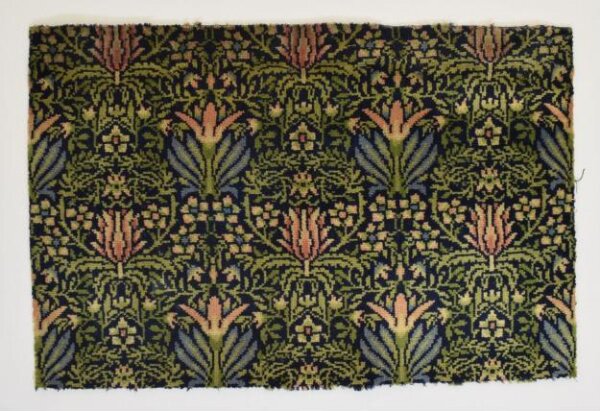
The 1842 Encyclopaedia Britannica: Wilton pile is cut, giving a velvet surface, while Brussels pile stays uncut; Wilton wires had a groove along which a knife called a 'travat' ran to cut the loops. Britain at Work (1920s) says Wilton was the first English town to make Brussels carpet and that its weavers fixed 'a little cutting blade at one end of the looping wires', creating the Wilton carpet. The NPS calls Wilton 'an offshoot of the Brussels technique made on the same narrow looms, but its loops were cut to give a smooth, velvety pile'. Merriam-Webster gives 1774 as the first known use of 'Wilton' for the carpet. Why it matters: cut pile on a loom is the direct ancestor of cut-pile broadloom, and cutting the loop with a blade is the same idea later used on tufting machines. Conflict: the VCH says the 1741 loom had no cutting device (see woven-wilton-1741-patent-moccadoes). Sources: https://jimclifford.ca/early_encyclopedia_britannica/articles/1842/eb_7th_1842_004597.html · https://tekniskkulturarv.dk/book/9ed6a0c7-3d5b-4bef-b920-e3a87a3a9e6e?page=335 · https://www.nps.gov/parkhistory/online_books/inde/anderson/chap2.htm · https://www.merriam-webster.com/dictionary/wiltons Research note (Oct 2026): from search results; pages not opened. The picture: the V&A's "Lily" carpet sample (object O89256), machine-woven woollen pile on jute, designed by William Morris about 1875 and woven for Morris & Co. by the Wilton Royal Carpet Factory Ltd (V&A catalogue; saved in research/fetched/api-vam-ac-uk-v2-museumobject-O89256.txt).