Shade 1Wheat5th–4th c. BCE–1971
How rugs are made, and where tufting fits
Rug-makers have tied pile by hand, raised it on the loom and sewn or hooked it into finished cloth; tufting puts pile into a backing that already exists, and that one change is what the rest of this book follows.

Key dates
- 5th–4th c. BCEThe Pazyryk knotted carpet
- 1800–20A yarn-sewn hearth rug, Connecticut
- 1832Whytock’s “Tapestry carpet loom” (date disputed)
- 1839Templeton and Quiglay’s chenille patent
- 1860Oldest known Canadian hooked rug
- 1891Ross’s “Turfing Implement”
- 1941Multiple-needle tufting machine filed
- 1971Flocked Flotex launched in Britain
In 1949 Sergei Rudenko’s excavation of Barrow 5 in the Pazyryk valley, in the Altai Mountains, found a wool pile carpet frozen in ice, after looters had left the tomb open.11Rudenko 1953, pp. 351–356, pl. CXV–CXVI; Rudenko 1968, ch. 2; Rudenko 1970, pp. 298–304, pl. 174–175; Opie, Tribal Rugs, ch. 3 (publications listed in the University of Washington Silk Road caption). Record Its pile is knotted: short lengths of yarn tied round pairs of warps, one row at a time, cut to height and locked with wefts. It is the oldest known knotted-pile carpet, and its date is still argued. Radiocarbon puts it in the 5th to 4th century BCE, while the Hermitage listing dates the barrow to 252–238 BCE.22Rudenko 1953, pp. 351–356, pl. CXV–CXVI; Rudenko 1968, ch. 2; Rudenko 1970, pp. 298–304, pl. 174–175; Opie, Tribal Rugs, ch. 3 (publications listed in the University of Washington Silk Road caption). Record
Tufting makes pile too, by a different route. In weaving, pile and backing are made together; tufting adds pile yarn to a backing that already exists.33“Tufting defined: needles push pile yarn through a ready-made backing, locked in with adhesive”, hand needle 18th–19th c.; machine from mid-20th c., research note. Record This chapter sorts the main ways of making a rug by that difference, so that a reader can tell tufting from the rest and see where it sits among them. The other twelve chapters tell the tufting story itself.
Pile tied by hand
The knot varies. The symmetric knot, called Turkish or Ghiordes, passes round two neighbouring warps and brings both ends up between them; it is the knot of the Pazyryk carpet. The asymmetric knot, called Persian or Senneh, wraps fully round one warp and partly round the next, and is said to allow finer, more curving designs.44“Knot types: symmetric (Turkish/Ghiordes) and asymmetric (Persian/Senneh)”, symmetric knot attested from 5th–4th century BCE (Pazyryk), research note. Record The Spanish knot is tied round a single warp, with alternate rows on alternate warps; the Textile Museum has an armorial carpet knotted this way and dated 1415–1458.55Single-warp ‘Spanish’ knot: armorial carpet, 1415–1458 (Textile Museum R44.4.1), 1415–1458, The George Washington University Museum and The Textile Museum, R44.4.1. Record
According to Britannica, Tibetan weavers work differently: the yarn is looped under a warp, brought towards the weaver over a metal gauge rod and looped round the next warp; after each row a knife run along a groove in the rod cuts the loops into pile.66“Tibetan 'slit-loop' knot: continuous yarn looped over a gauge rod, then cut”, tradition undated; similar technique in Coptic Egyptian and Central Asian fragments (Britannica), research note. Record Loops first, cut afterwards: tufting, too, leaves loops that can then be cut.77“Tufting defined: needles push pile yarn through a ready-made backing, locked in with adhesive”, hand needle 18th–19th c.; machine from mid-20th c., research note. Record
Spacing changes the fabric. The Finnish ryijy, or rya, has long knotted pile in widely spaced rows, with many ground picks between them, giving a shaggy, heavy cloth first used as a bedcover; the Victoria and Albert Museum has one marked with the initials AFBD and the date 1814.88Finnish ryijy (rya) with long knotted pile, dated 1814 (V&A T.123-1924), 1814 (object); documented from mid-15th century, Victoria and Albert Museum, T.123-1924. Record Knotting was also a European manufacture. A carpet attributed to Thomas Whitty of the Axminster carpet manufactory in Devon, and dated about 1765, is hand-knotted wool.99Axminster carpet attributed to Thomas Whitty, ca. 1765 (Met 2025.725), ca. 1765, The Metropolitan Museum of Art, 2025.725. Record
Rugs without pile: felt and flatweave
Felt is not woven at all. Britannica defines it as wool, fur or some hair fibres interlocked by heat, moisture and friction, with no adhesive, and says that non-woven felts are considered the first textile goods produced.1010“Felt: fibres matted together with heat, moisture and friction rather than woven”, before weaving (traditional claim); firm evidence from 5th–3rd century BCE (Pazyryk), research note. Record The firmest early evidence found for felt floor and wall coverings comes from the Pazyryk burials: appliqué hangings, saddlecloths and cushions, of felt cut and sewn onto felt grounds.1111“Felt: fibres matted together with heat, moisture and friction rather than woven”, before weaving (traditional claim); firm evidence from 5th–3rd century BCE (Pazyryk), research note. Record Pazyryk felt appliqué hangings and furnishings (Altai burial mounds), 5th–3rd century BCE (dating disputed), State Hermitage Museum, St Petersburg, not found (inventory numbers for these felts were not in search results). Record

Felt rugs are still made. Kyrgyz shyrdak makers cut two felts of contrasting colour at once, swap the pieces and sew them onto a coarser felt base, a craft UNESCO placed on its Urgent Safeguarding List in 2012.1212Kyrgyz shyrdak: felt cut in counterchange, sewn and quilted (British Museum As1995,20.14), object 1955; craft listed by UNESCO 2012, British Museum, As1995,20.14. Record
Flatweaves have no pile. Kilims, Navajo blankets, dhurries and Swedish rölakan are all tapestry-woven: a weft-faced plain weave in which each coloured weft runs back and forth only where its colour is needed and is packed down to hide the warp. Britannica dates the earliest known tapestry to Egyptian linen of 1483–1411 BCE from the tomb of Thutmose IV; a 1923 account gives the tomb of Thutmose III and 1500–1400 BCE.1313“Earliest tapestry weave: linen fragments from the tomb of Thutmose IV, Egypt (c. 1483–1400 BCE)”, c. 1483–1411 BCE (Britannica); 1500–1400 BCE (Glazier 1923), Egyptian Museum, Cairo (CG 46526, per V&A), CG 46526. Record
Where two colours meet in a kilim, the weaver can leave a slit, dovetail the two wefts round a shared warp, or interlock them; the Fine Arts Museums of San Francisco hold a 17th-century kilim in slit tapestry.1414Kilim in slit tapestry, 17th century (Fine Arts Museums of San Francisco 1988.11.561), 17th century, Fine Arts Museums of San Francisco (Caroline and H. McCoy Jones Collection), 1988.11.561. Record

In India the cotton dhurrie is beaten down with a panja, a hand tool with metal prongs, until the wefts cover the warp. The Penn Museum says that dhurries of the late 19th century were mostly made by prison labour.1515Cotton dhurrie, North India, late 19th century (Penn Museum 29-96-81), late 19th century, Penn Museum (University of Pennsylvania Museum of Archaeology and Anthropology), 29-96-81. Record Navajo weavers work tapestry on an upright loom with no moving parts; from the 1880s traders such as J. L. Hubbell at Ganado steered them towards bordered floor rugs for Anglo buyers.1616“Navajo (Diné) weaving: tapestry on the upright loom, from wearing blankets (1600s–) to floor rugs (1880s–1920)”, weaving c. 1600–1700 (disputed); rug era c. 1880–1920, research note. Record
Pile made on the loom
In Europe pile moved onto the loom, the subject of chapter 3. In Brussels carpet, long steel wires are inserted between the linen and worsted warps, and the worsted loops up over them.1717“Brussels carpet: looped wool pile raised over steel wires on the loom”, by the 1740s, research note. Record Wilton is the cut-pile form of Brussels, made on the same narrow looms.1818“Brussels carpet: looped wool pile raised over steel wires on the loom”, by the 1740s, research note. Record “Wilton: Huguenot weavers (1720s) and the first Wilton loom (1741)”, 1720s–1741, research note. Record Where Brussels carpet ran five or six coloured yarns in every pile line, Richard Whytock of Edinburgh printed the pattern onto a single pile warp before weaving. The Glasgow School of Art Archives say he patented his “Tapestry carpet loom” in 1832; another account dates it to about 1840, and the patent has not been found.1919‘Tapestry’ carpet: pile from warp yarns printed before weaving (Richard Whytock, Edinburgh, patented 1832); V&A sample c. 1850, patent 1832 (GSA Archives); 'about 1840' (Britain at Work); sample c. 1850, Victoria and Albert Museum, V&A system no. O258617 (museum number not seen). Record
James Templeton and William Quiglay, in Glasgow, patented an improved chenille method in July 1839. A “weft blanket” is woven in the pattern colours and cut into strips; each strip is folded into a furry chenille yarn, which is woven into a backing as the pile weft. The result is seamless cut pile without tying a knot.2020Chenille Axminster: James Templeton and William Quiglay’s chenille patent (Glasgow, 1839); V&A Templeton sample, patent July 1839; sample late 19th century, Victoria and Albert Museum, V&A system no. O352290 (museum number not seen). Record In 1876, according to Britannica’s student encyclopedia, Halcyon Skinner perfected a power loom for Royal Axminster that made patterned cut-pile carpet cheaper, a claim still to be checked against a second source.2121“Halcyon Skinner perfected the power loom for Royal Axminster (1876)”, 1876, research note. Record
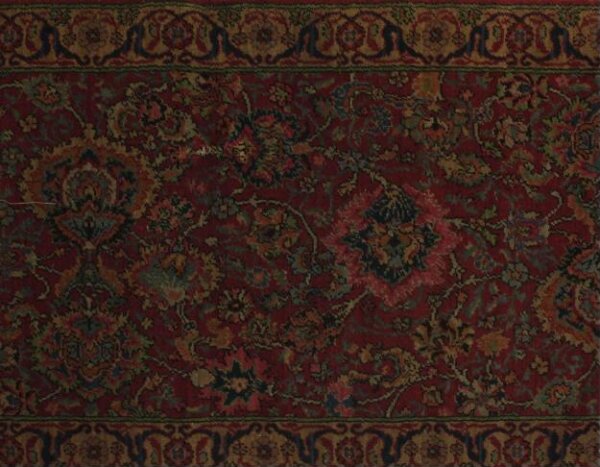
A spool Axminster loom photographed at Shaw Industries in Dalton shows the principle. Chains overhead carry spools, each wound with one row of coloured pile yarn, and the loom takes one spool at a time, inserts a row of tufts, cuts them and weaves them in. The identification is from the photograph alone.2222“Spool Axminster power loom (identified from photograph)”, undated; the spool Axminster type dates from Skinner's 1876 loom, Shaw Industries, Dalton, Georgia. Record In all of these, the loom makes the pile and its backing together.2323“Tufting defined: needles push pile yarn through a ready-made backing, locked in with adhesive”, hand needle 18th–19th c.; machine from mid-20th c., research note. Record
Pile added to a finished cloth
Other rugs start from cloth that is already woven. In a yarn-sewn rug, yarn is sewn with a needle in a continuous running stitch through a closely woven cloth, leaving loops on the face that are usually clipped.2424Yarn-sewn hearth rug, 1800–1820 (Connecticut Historical Society 2010.409.0), 1800–1820, Connecticut Historical Society, 2010.409.0. Record
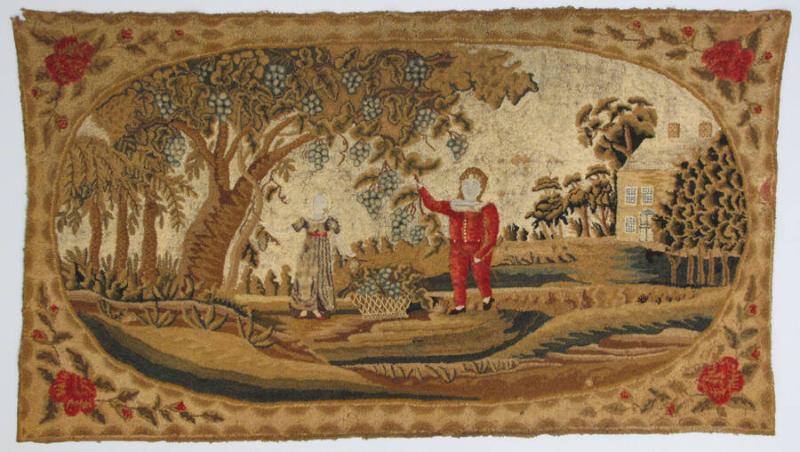
The Connecticut Historical Society’s hearth rug of 1800–1820 shows a boy and girl under a grapevine, with roses in the corners. The Metropolitan Museum’s bed rugs use the same needle-worked running stitch, “not hooked, as was once assumed”.2525Yarn-sewn hearth rug, 1800–1820 (Connecticut Historical Society 2010.409.0), 1800–1820, Connecticut Historical Society, 2010.409.0. Record Bed rug, 1809, The Metropolitan Museum of Art, 13.207. Record Those bed rugs are the subject of chapter 2.
Shirred rugs sew strips of fabric onto the foundation. In chenille shirring a strip is stitched lengthwise down the middle and gathered into a caterpillar-like strand, which is sewn flat along the pattern. Historic New England’s “Apple Tree Farm” rug, from Cogswell’s Grant in Essex, Massachusetts, is dated 1820–1830.2626Shirred rug ‘Apple Tree Farm’, 1820–1830 (Historic New England 1991.1525), 1820–1830, Historic New England, 1991.1525. Record
Hooking pulls strips of fabric or yarn up through a woven foundation, usually burlap, with a hook, making loops on the surface. Where it began is argued. W. W. Kent’s The Hooked Rug (1930) traced it to Yorkshire, as Wikipedia reports; a Colonial Williamsburg label says it seems to have begun in New England and south-east Canada in the 1840s and spread once burlap arrived.2727“Rug hooking’s origin debate: Yorkshire (Kent), or several centres at once (Québec, Maritimes, New England); burlap from the 1850s”, 1840s–1860 (earliest firm North American dates), research note. Record Hooked rug on burlap, ca. 1875 (Colonial Williamsburg 1983.611.1), ca. 1875, Colonial Williamsburg Foundation, 1983.611.1. Record The Canadian Museum of History says burlap was not sold commercially in North America until the 1850s, and that the oldest known Canadian hooked rug was hooked in 1860 by Abigail Smith, aged 13, at New Maryland, New Brunswick.2828“Rug hooking’s origin debate: Yorkshire (Kent), or several centres at once (Québec, Maritimes, New England); burlap from the 1850s”, 1840s–1860 (earliest firm North American dates), research note. Record
Hooking could also be organised as outwork. The Grenfell Mission in northern Newfoundland and Labrador gave women kits of pre-dyed material and burlap stencilled with designs, then sold the mats to fund its medical work; sources date the start to 1906, 1909 or 1913.2929“Grenfell mats: a mission cottage industry of hooked mats in Newfoundland and Labrador (1906/1909/1913 to late 1960s)”, founded 1906, 1909 or 1913 (sources differ); peak late 1920s–early 1930s, research note. Record Its “Polar Bear on Ice Floe” of about 1930, in the Baltimore Museum of Art, is hooked in wool and rayon or silk jersey on jute burlap; the Mission supplied used stockings donated by women in North American and British cities.3030Grenfell hooked mat ‘Polar Bear on Ice Floe’, c. 1930 (Baltimore Museum of Art 1996.165), c. 1930, Baltimore Museum of Art, 1996.165. Record
When your stockings run, let them run to Labrador!
Grenfell Mission slogan, quoted by the Baltimore Museum of ArtNeedle tools were patented too. Ebenezer Ross of Toledo, Ohio, patented a two-handled needle-and-gauge tool in 1891 as a “Turfing Implement” (chapter 9).3131Ebenezer Ross, “Turfing Implement” (US463548A), patented 17 Nov 1891. Record Some strip rugs need no foundation cloth at all. Braided rugs coil a three-strand braid of cloth strips and sew it edge to edge into a round or oval mat; Historic New England’s circular braided wool rug from Castle Tucker, Wiscasset, Maine, is dated 1860–1890, and no museum-dated braided rug earlier than that has yet been found.3232Circular braided wool rug, 1860–1890 (Historic New England 1998.1344), 1860–1890, Historic New England, 1998.1344. Record Crocheted rugs work strips into chained loops with a hook. The American Folk Art Museum’s crocheted rug of 1880–1900 uses hand-dyed wool, woven wool cloth and recycled ingrain carpet.3333Crocheted rug, 1880–1900 (American Folk Art Museum 1985.21.1), 1880–1900, American Folk Art Museum, 1985.21.1. Record
Tufting
Tufting belongs with the needle-made rugs. A needle, or a bar of hundreds of needles, pierces a primary backing and leaves loops, which can be cut. The tufts are then locked with latex or another adhesive, often laminated to a secondary backing. Unlike a loom, the tufting needle does not make the cloth it works in, and Britannica’s student encyclopedia names weaving and tufting as the two main methods of making carpet today.3434“Tufting defined: needles push pile yarn through a ready-made backing, locked in with adhesive”, hand needle 18th–19th c.; machine from mid-20th c., research note. Record
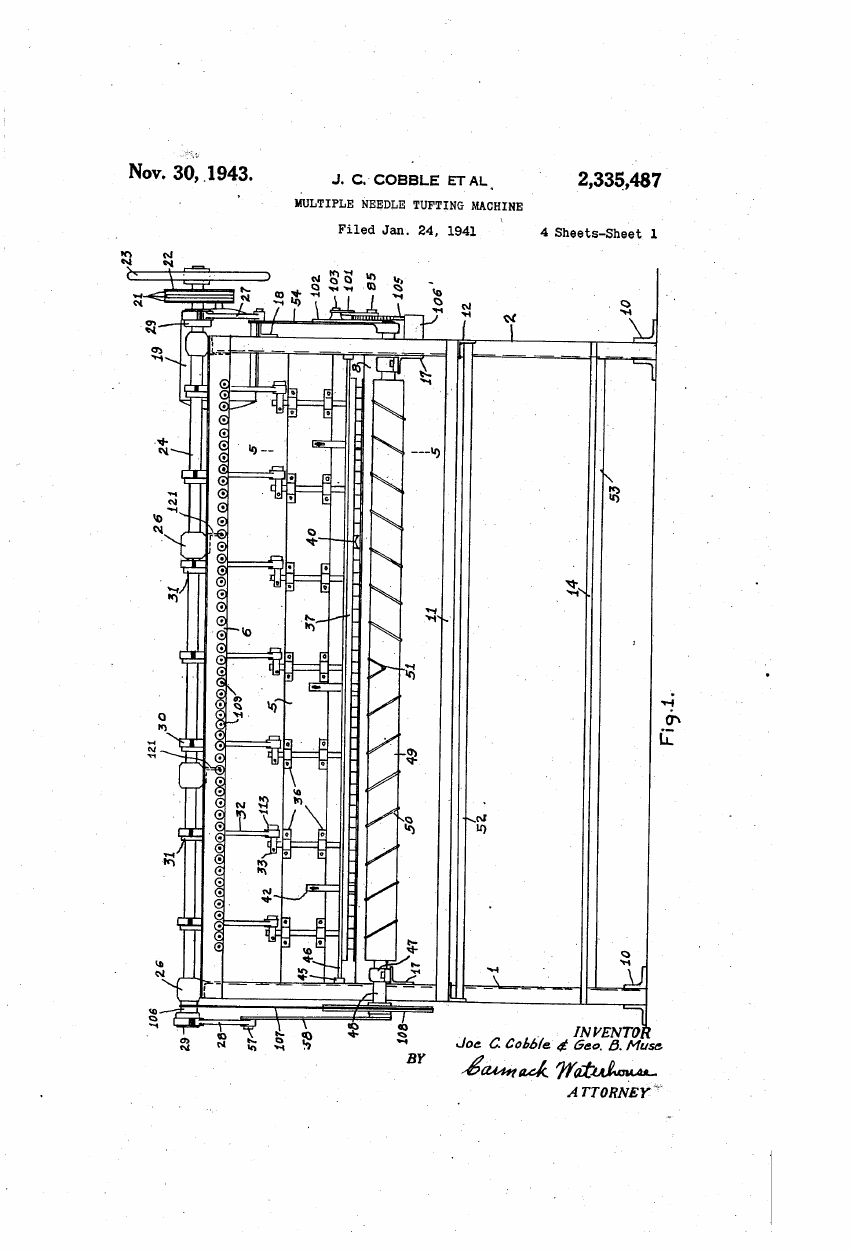
The tools were mechanised in the 20th century. Joe C. Cobble and George B. Muse’s “Multiple Needle Tufting Machine” was filed in January 1941 and granted in November 1943.3535Joe C. Cobble, “Multiple Needle Tufting Machine” (US2335487A), filed 24 Jan 1941, granted 30 Nov 1943. Record According to the Carpet and Rug Institute, machinery developed for making chenille rugs was widened to make larger rugs and broadloom carpet (chapters 4 and 5).3636Carpet and Rug Institute, web page on the history of carpet, carpet-rug.org (quoted from search results; page not yet checked). Record By one count, still to be traced to its source, 10 per cent of American carpet was tufted in 1950.3737“1950: 10% of US carpet was tufted; today over 90%”, 1950–today, research note. Record One textile source puts tufted products at more than 90 per cent of carpet now.3838“Tufting defined: needles push pile yarn through a ready-made backing, locked in with adhesive”, hand needle 18th–19th c.; machine from mid-20th c., research note. Record
Other industrial methods
Industry has other ways to make a floor covering, some with no yarn at all. In needle-punching, barbed needles drag fibres through a loose web and tangle them into a felt-like fabric; one educational source says needled synthetics entered home furnishings in the late 1950s.3939“Needle-punch (needlefelt): barbed needles mat a fibre web into a non-woven floor covering (padding from late 1800s; synthetics late 1950s)”, late 1800s (padding); late 1950s (synthetic home-furnishing products); mid-1980s (random velour looms), research note. Record A 2007 trade article credits the Dutch firm Heuga with the first carpet tile, a bitumen-backed needlefelt square, about fifty years earlier; British retailers say instead that Heuga was founded in 1956, or that the first commercial tile came in 1958.4040“Carpet tiles: Heuga’s bitumen-backed needlefelt squares (Netherlands, c. 1956–58)”, c. 1956–1958 (sources differ), research note. Record
Flocked flooring shoots cut nylon fibres, charged in an electric field, end-first into wet adhesive so that they stand upright. BD Online and Forbo say the first was made by Flotex at Château-Renault in France in the 1960s; Low & Bonar launched it in Britain in November 1971.4141“Flocked floor covering (Flotex): short nylon fibres shot upright into adhesive by an electric field (France, 1960s; UK 1971–72)”, 1960s (France); 1971 UK launch; Ripley factory 1972, research note. Record Fusion bonding sets pile yarn into a layer of adhesive, usually PVC; Encyclopedia.com says Milliken bought the American rights to the English process in July 1969, but when it was invented has not been found.4242“Fusion-bonded carpet: cut pile yarn set into a PVC adhesive layer (Debron, Kidderminster; US rights to Milliken 1969)”, by 1969, research note. Record Knitted carpet loops pile and backing yarns together in one operation, and no date for its introduction has been found.4343“Knitted carpet: pile and backing yarns looped together in one knitting operation”, date not found, research note. Record
Printing adds pattern after the carpet is made. Dye is forced through a stencilled screen, one for each colour, into plain carpet, usually tufted. The Austrian firm Zimmer dates its carpet printing on a flat-bed machine to 1962 and its large rotary-screen carpet printing to 1968. Later machines inject dye from computer-controlled jets, with no screens.4444“Printed carpet: flat-screen (1962) and rotary-screen (1968) printing of pile carpet, then jet dyeing”, 1962 (flat-screen carpet printer); 1968 (large rotary screen); 1970s jet printing, research note. Record
This chapter argues that tufting belongs with the sewn and hooked rugs rather than with the loom. Like them, it puts pile into a cloth that already exists, and that separation of pile from backing is what sets it apart from knotting and weaving.
Notes
- 1Rudenko 1953, pp. 351–356, pl. CXV–CXVI; Rudenko 1968, ch. 2; Rudenko 1970, pp. 298–304, pl. 174–175; Opie, Tribal Rugs, ch. 3 (publications listed in the University of Washington Silk Road caption). depts.washington.edu/silkroad/museums/shm/shmpazyryk.html. Record
- 2Rudenko 1953, pp. 351–356, pl. CXV–CXVI; Rudenko 1968, ch. 2; Rudenko 1970, pp. 298–304, pl. 174–175; Opie, Tribal Rugs, ch. 3 (publications listed in the University of Washington Silk Road caption). depts.washington.edu/silkroad/museums/shm/shmpazyryk.html. Record
- 3“Tufting defined: needles push pile yarn through a ready-made backing, locked in with adhesive.” Research note. kids.britannica.com/students/article/rug-and-carpet/276811. Record
- 4“Knot types: symmetric (Turkish/Ghiordes) and asymmetric (Persian/Senneh).” Research note. en.wikipedia.org/wiki/Knotted-pile_carpet. Record
- 5Mudéjar weavers. Single-warp ‘Spanish’ knot: armorial carpet, 1415–1458 (Textile Museum R44.4.1), 1415–1458. The George Washington University Museum and The Textile Museum, R44.4.1. collections-gwu.zetcom.net/en/collection/item/7980. Record
- 6“Tibetan 'slit-loop' knot: continuous yarn looped over a gauge rod, then cut.” Research note. britannica.com/art/Tibetan-carpet. Record
- 7“Tufting defined: needles push pile yarn through a ready-made backing, locked in with adhesive.” Research note. kids.britannica.com/students/article/rug-and-carpet/276811. Record
- 8Unknown maker. Finnish ryijy (rya) with long knotted pile, dated 1814 (V&A T.123-1924), 1814 (object); documented from mid-15th century. Victoria and Albert Museum, T.123-1924. collections.vam.ac.uk/item/O102075/carpet-unknown. Record
- 9Attributed to Thomas Whitty (1713–1792); Axminster carpet manufactory. Axminster carpet attributed to Thomas Whitty, ca. 1765 (Met 2025.725), ca. 1765. The Metropolitan Museum of Art, 2025.725. metmuseum.org/art/collection/search/928622. Record
- 10“Felt: fibres matted together with heat, moisture and friction rather than woven.” Research note. britannica.com/technology/felt. Record
- 11“Felt: fibres matted together with heat, moisture and friction rather than woven.” Research note. britannica.com/technology/felt. Record Pazyryk culture (Early Iron Age Altai). Pazyryk felt appliqué hangings and furnishings (Altai burial mounds), 5th–3rd century BCE (dating disputed). State Hermitage Museum, St Petersburg, not found (inventory numbers for these felts were not in search results). depts.washington.edu/silkroad/museums/shm/shmpazyryk.html. Record
- 12Kyrgyz women felt-makers. Kyrgyz shyrdak: felt cut in counterchange, sewn and quilted (British Museum As1995,20.14), object 1955; craft listed by UNESCO 2012. British Museum, As1995,20.14. britishmuseum.org/collection/object/W_As1995-20-14. Record
- 13“Earliest tapestry weave: linen fragments from the tomb of Thutmose IV, Egypt (c. 1483–1400 BCE).” Research note. britannica.com/art/tapestry/Periods-and-centres-of-activity. Record
- 14Unknown maker. Kilim in slit tapestry, 17th century (Fine Arts Museums of San Francisco 1988.11.561), 17th century. Fine Arts Museums of San Francisco (Caroline and H. McCoy Jones Collection), 1988.11.561. famsf.org/artworks/kilim. Record
- 15Unknown maker. Cotton dhurrie, North India, late 19th century (Penn Museum 29-96-81), late 19th century. Penn Museum (University of Pennsylvania Museum of Archaeology and Anthropology), 29-96-81. collections.penn.museum/collections/object/72254. Record
- 16“Navajo (Diné) weaving: tapestry on the upright loom, from wearing blankets (1600s–) to floor rugs (1880s–1920).” Research note. statemuseum.arizona.edu/online-exhibit/19-century-navajo-weaving-asm/navajo-weaving-methods. Record
- 17“Brussels carpet: looped wool pile raised over steel wires on the loom.” Research note. britannica.com/topic/Brussels-carpet. Record
- 18“Brussels carpet: looped wool pile raised over steel wires on the loom.” Research note. britannica.com/topic/Brussels-carpet. Record “Wilton: Huguenot weavers (1720s) and the first Wilton loom (1741).” Research note. wiltoncarpets.com/about-us/our-heritage. Record
- 19Richard Whytock (inventor); G. P. Simcox, Kidderminster (sample maker). ‘Tapestry’ carpet: pile from warp yarns printed before weaving (Richard Whytock, Edinburgh, patented 1832); V&A sample c. 1850, patent 1832 (GSA Archives); 'about 1840' (Britain at Work); sample c. 1850. Victoria and Albert Museum, V&A system no. O258617 (museum number not seen). collections.vam.ac.uk/item/O258617. Record
- 20James Templeton; William Quiglay (Quigley). Chenille Axminster: James Templeton and William Quiglay’s chenille patent (Glasgow, 1839); V&A Templeton sample, patent July 1839; sample late 19th century. Victoria and Albert Museum, V&A system no. O352290 (museum number not seen). collections.vam.ac.uk/item/O352290/carpet-james-templeton. Record
- 21“Halcyon Skinner perfected the power loom for Royal Axminster (1876).” Research note. kids.britannica.com/students/article/rug-and-carpet/276811. Record
- 22Unknown maker. Spool Axminster power loom (identified from photograph), undated; the spool Axminster type dates from Skinner's 1876 loom. Shaw Industries, Dalton, Georgia. Record
- 23“Tufting defined: needles push pile yarn through a ready-made backing, locked in with adhesive.” Research note. kids.britannica.com/students/article/rug-and-carpet/276811. Record
- 24Unknown maker. Yarn-sewn hearth rug, 1800–1820 (Connecticut Historical Society 2010.409.0), 1800–1820. Connecticut Historical Society, 2010.409.0. emuseum.chs.org/emuseum/objects/13050/hearth-rug. Record
- 25Unknown maker. Yarn-sewn hearth rug, 1800–1820 (Connecticut Historical Society 2010.409.0), 1800–1820. Connecticut Historical Society, 2010.409.0. emuseum.chs.org/emuseum/objects/13050/hearth-rug. Record Attributed to "M. B.". Bed rug, 1809. The Metropolitan Museum of Art, 13.207. metmuseum.org/art/collection/search?q=13.207. Record
- 26Unknown maker. Shirred rug ‘Apple Tree Farm’, 1820–1830 (Historic New England 1991.1525), 1820–1830. Historic New England, 1991.1525. historicnewengland.org/explore/collections-access/gusn/3034. Record
- 27“Rug hooking’s origin debate: Yorkshire (Kent), or several centres at once (Québec, Maritimes, New England); burlap from the 1850s.” Research note. web.archive.org/web/20240319123851/https://www.historymuseum.ca/cmc/exhibitions/arts/rugs/rugs02e.html. Record Unknown maker. Hooked rug on burlap, ca. 1875 (Colonial Williamsburg 1983.611.1), ca. 1875. Colonial Williamsburg Foundation, 1983.611.1. emuseum.colonialwilliamsburg.org/objects/59028/hooked-rug. Record
- 28“Rug hooking’s origin debate: Yorkshire (Kent), or several centres at once (Québec, Maritimes, New England); burlap from the 1850s.” Research note. web.archive.org/web/20240319123851/https://www.historymuseum.ca/cmc/exhibitions/arts/rugs/rugs02e.html. Record
- 29“Grenfell mats: a mission cottage industry of hooked mats in Newfoundland and Labrador (1906/1909/1913 to late 1960s).” Research note. textilemuseum.ca/collection/hooked-rug-t84-0117. Record
- 30Grenfell Mission Industrial Department (label: Grenfell Labrador Industries). Grenfell hooked mat ‘Polar Bear on Ice Floe’, c. 1930 (Baltimore Museum of Art 1996.165), c. 1930. Baltimore Museum of Art, 1996.165. artbma.org/artwork/polar-bear-on-ice-floe. Record
- 31Ebenezer Ross, “Turfing Implement” (US463548A), patented 17 Nov 1891. patents.google.com/patent/US463548A/en. Record
- 32Unknown maker. Circular braided wool rug, 1860–1890 (Historic New England 1998.1344), 1860–1890. Historic New England, 1998.1344. historicnewengland.org/explore/collections-access/gusn/18698. Record
- 33Unknown maker. Crocheted rug, 1880–1900 (American Folk Art Museum 1985.21.1), 1880–1900. American Folk Art Museum, 1985.21.1. collection.folkartmuseum.org/objects/922/crocheted-rug. Record
- 34“Tufting defined: needles push pile yarn through a ready-made backing, locked in with adhesive.” Research note. kids.britannica.com/students/article/rug-and-carpet/276811. Record
- 35Joe C. Cobble, “Multiple Needle Tufting Machine” (US2335487A), filed 24 Jan 1941, granted 30 Nov 1943. patents.google.com/patent/US2335487A/en. Record
- 36Carpet and Rug Institute, web page on the history of carpet, carpet-rug.org (quoted from search results; page not yet checked). carpet-rug.org/about-us/history-of-carpet. Record
- 37“1950: 10% of US carpet was tufted; today over 90%.” Research note, TTW Script Bank fact-check notes (Claude research, Aug 2026). Record
- 38“Tufting defined: needles push pile yarn through a ready-made backing, locked in with adhesive.” Research note. kids.britannica.com/students/article/rug-and-carpet/276811. Record
- 39“Needle-punch (needlefelt): barbed needles mat a fibre web into a non-woven floor covering (padding from late 1800s; synthetics late 1950s).” Research note. apparelsearch.com/education/research/nonwoven/2001_kermit_duckett/education_research_nonwoven_needle_punched_nonwovens.htm. Record
- 40“Carpet tiles: Heuga’s bitumen-backed needlefelt squares (Netherlands, c. 1956–58).” Research note. floordaily.net/floorfocus/carpet-tile-50-years-later-augsep-2007. Record
- 41“Flocked floor covering (Flotex): short nylon fibres shot upright into adhesive by an electric field (France, 1960s; UK 1971–72).” Research note. bdonline.co.uk/cpd/cpd-26-2013-electrostatically-flocked-flooring/5063206.article. Record
- 42“Fusion-bonded carpet: cut pile yarn set into a PVC adhesive layer (Debron, Kidderminster; US rights to Milliken 1969).” Research note. floordaily.net/floorfocus/carpet-tile-50-years-later-augsep-2007. Record
- 43“Knitted carpet: pile and backing yarns looped together in one knitting operation.” Research note. kids.britannica.com/students/article/rug-and-carpet/276811. Record
- 44“Printed carpet: flat-screen (1962) and rotary-screen (1968) printing of pile carpet, then jet dyeing.” Research note. web.archive.org/web/20230616194018/https://www.zimmer-austria.com/en/node/6296. Record
Where the sources are
- Research notes, not yet traced to a public source18
- Victoria and Albert Museum3
- State Hermitage Museum, St Petersburg2
- The Metropolitan Museum of Art2
- Historic New England2
- US patents2
- The George Washington University Museum and The Textile Museum1
- British Museum1
- Egyptian Museum, Cairo (CG 46526, per V&A)1
- Fine Arts Museums of San Francisco (Caroline and H. McCoy Jones Collection)1
- Penn Museum (University of Pennsylvania Museum of Archaeology and Anthropology)1
- Shaw Industries, Dalton, Georgia1
- Connecticut Historical Society1
- Colonial Williamsburg Foundation1
- Baltimore Museum of Art1
- American Folk Art Museum1