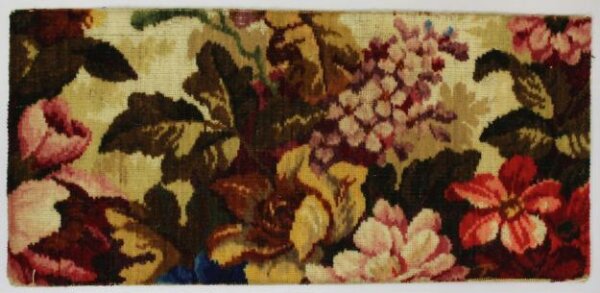
'Tapestry' carpet: pile from warp yarns printed before weaving (Richard Whytock, Edinburgh, patented 1832); V&A sample c. 1850
Object · not yet checked at the source · Image permission pending
- Made by
- Richard Whytock (inventor); G. P. Simcox, Kidderminster (sample maker)
- Date
- patent 1832 (GSA Archives); 'about 1840' (Britain at Work); sample c. 1850
- Place
- Edinburgh; Kidderminster
- Held by
- Victoria and Albert Museum
- Number
- V&A system no. O258617 (museum number not seen)
- Materials
- wool, linen, cotton backing
- Themes
- Rug-making techniques, Woven carpet
Cite this source
Research notes
How it works: in Brussels carpet, five or six coloured worsted yarns run in every pile line and the Jacquard lifts the needed colour over the wire. Whytock instead printed the pattern onto one pile warp before weaving, allowing for the take-up of the loops. The result was a lighter Brussels-like carpet with one layer of wool on a linen foundation, cut (velvet) or uncut (tapestry) (Britain at Work). History: the Glasgow School of Art Archives (Henry Widnell & Stewart / Stoddard-Templeton records) say the Board of Trustees sent Whytock to Brussels in 1830, he returned unimpressed, and he invented and patented the 'Tapestry carpet loom' in 1832. They add that the loom used one thread instead of five or six and was a third the size of a Brussels loom. Conflict: Britain at Work dates the invention to about 1840, and the patent itself was not found. This object: a tapestry-carpet sample with velvet pile and printed warp, flowers and leaves on a creamy ground, by G. P. Simcox of Kidderminster, c. 1850. The V&A also has an 1851 Henderson & Widnell (Lasswade) printed-warp sample, O366782. Builds on the existing woven-brussels-wire-loop record. Sources: https://catalogue.gsaarchives.net/index.php/henry-widnell-stewart-ltd · https://tekniskkulturarv.dk/book/9ed6a0c7-3d5b-4bef-b920-e3a87a3a9e6e?page=338 · https://collections.vam.ac.uk/item/O258617 · https://collections.vam.ac.uk/item/O366782 Research note (Oct 2026): from search results; pages not opened.