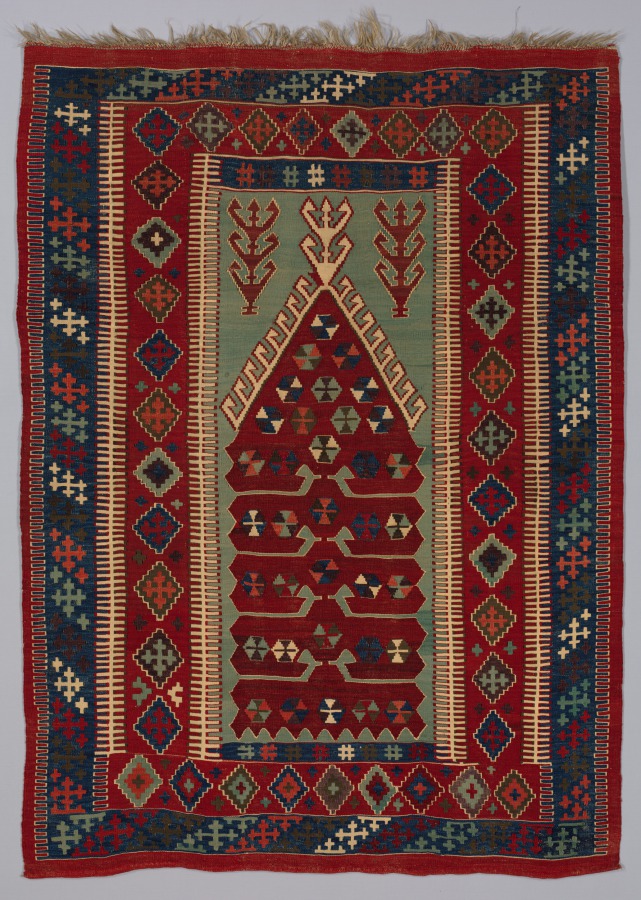
Kilim in slit tapestry, 17th century (Fine Arts Museums of San Francisco 1988.11.561)
Object · not yet checked at the source · Image permission pending
- Date
- 17th century
- Place
- Anatolia (per collection grouping)
- Held by
- Fine Arts Museums of San Francisco (Caroline and H. McCoy Jones Collection)
- Number
- 1988.11.561
- Materials
- wool, cotton
- Themes
- Rug-making techniques
Cite this source
Research notes
How kilims are joined: a kilim is a weft-faced plain weave. Where two colours meet along a vertical line, the weaver can (1) turn each weft back round its own warp, leaving a slit (slit tapestry). (2) Dovetail, with both wefts wrapping the same warp in turn. (3) Interlock, with the two wefts looping through each other. Slits give crisp outlines, while dovetailing and interlocking close the gap but blur the edge (Art Institute of Chicago guide to tapestry structures; Wikipedia 'Kilim'; Marla Mallett). This object: wool and cotton, slit-tapestry weave, 17th century. FAMSF also has 2003.87.5 (17th–18th century). The Textile Museum (GWU) has a late-19th-century Aydınlı kilim, 2011.10.2. Conflict on 'earliest kilim': James Mellaart argued that wall paintings at Neolithic Çatalhöyük copied kilims (published in The Goddess from Anatolia, 1989). No woven remains were found, and Marla Mallett and Murray Eiland argued in Oriental Rug Review (1990) that his reconstructed drawings were unreliable or fabricated. Treat Neolithic kilim claims as unproven. Sources: https://www.famsf.org/artworks/kilim · https://archive.artic.edu/divineart/weavingstruc · https://en.wikipedia.org/wiki/Kilim · https://www.marlamallett.com/techniques · https://daily.jstor.org/catalhoyuk-its-story-continues Research note (Oct 2026): from search results; pages not opened.