Shade 9Rust1891–1990
From the turfing implement to the tufting gun
Hand rug tools like Ross's of 1891 gained a motor, air, a trigger and a name one patent at a time; in the 1970s a German inventor patented an air-fed gun, and by one account a Hong Kong maker motorised its own.
Key dates
- 1891Ross’s “Turfing Implement”
- 1932A motor in a handheld tufting tool
- 1946Compressed air drives a hand rug tool
- 1952A handheld device with a trigger
- 1962“Tufting gun” in a patent filing
- 1973Scholz files for a hand-tufting device
- 1973Tai Ping fits its gun with a motor, by a Hong Kong heritage account
- 1990A “Hand-held Tufting Mending Gun” from Dalton
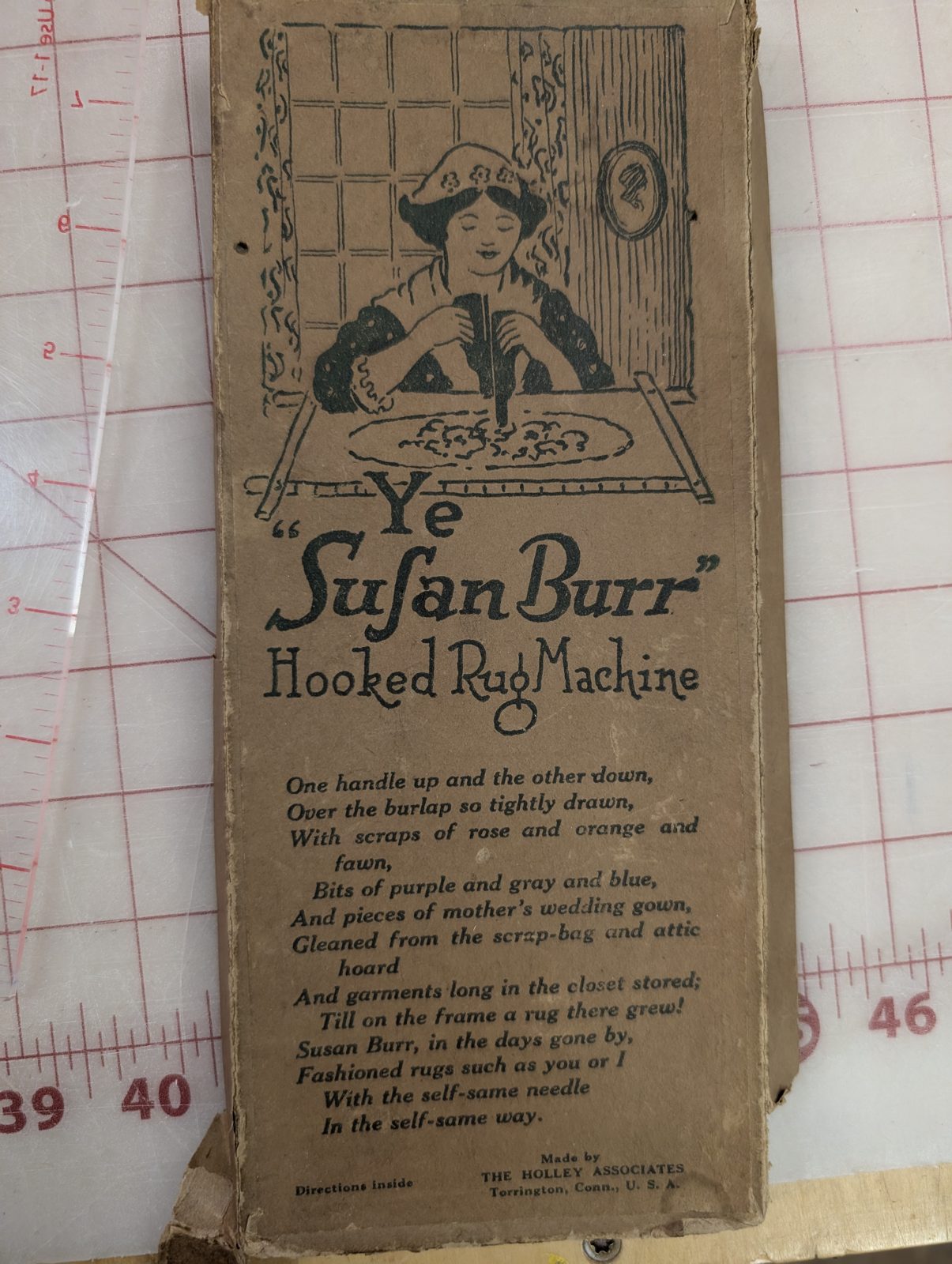
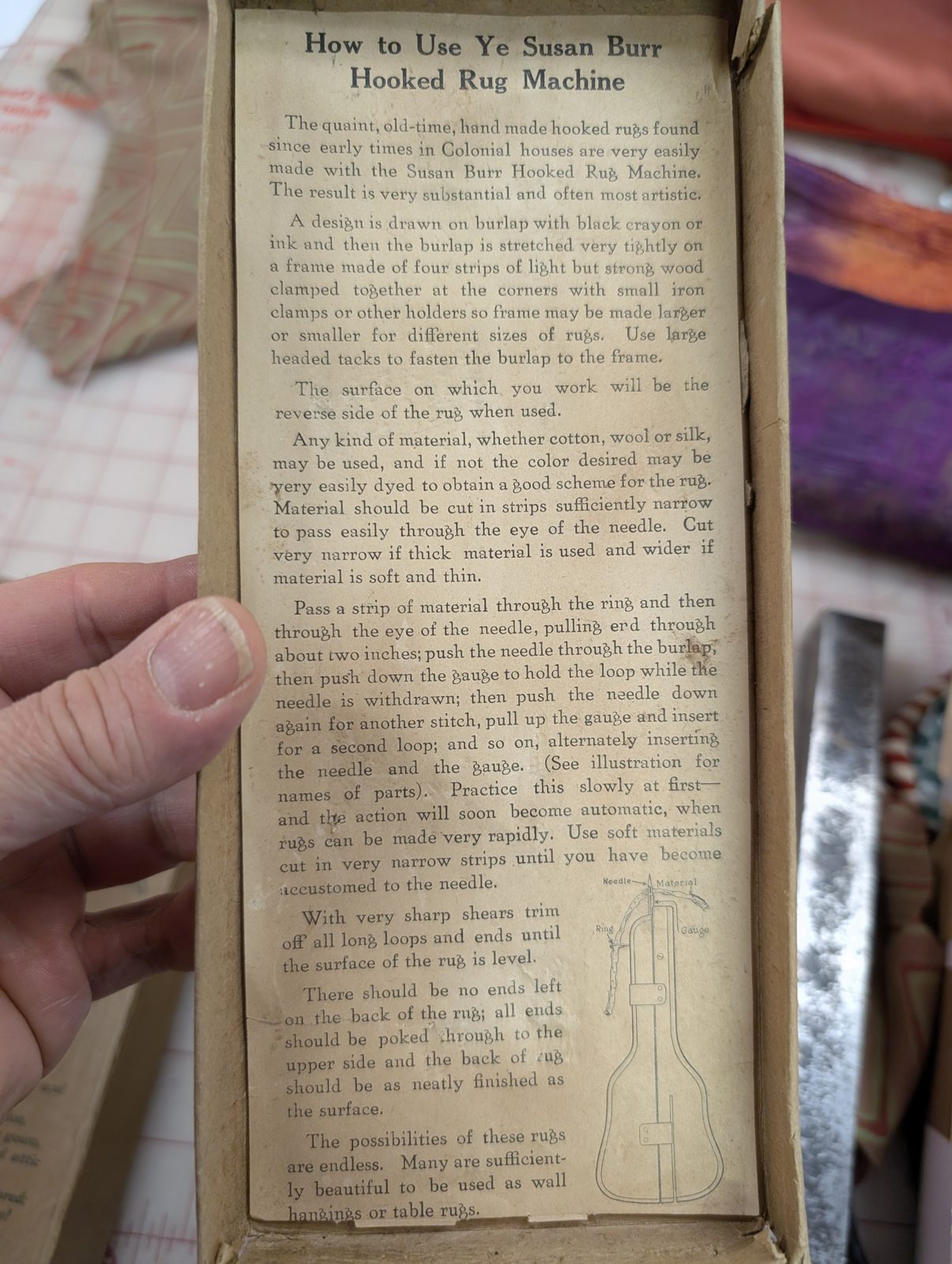
A cardboard box in the Tuft the World collection holds a rug tool with two wooden handles that slide against each other: a steel needle in one, a gauge in the other. The box names its maker, The Holley Associates of Torrington, Connecticut. The printed instructions inside describe the action: insert the needle, then “push down the gauge to hold the loop while the needle is withdrawn”, and so on, “alternately inserting the needle and the gauge”.11“Ye ‘Susan Burr’ Hooked Rug Machine”, c. 1920s–1930s, Tuft the World (own collection). Record The box carries a poem.
Susan Burr, in the days gone by, / Fashioned rugs such as you or I / With the self-same needle / In the self-same way.
Box of Ye “Susan Burr” Hooked Rug Machine, The Holley Associates, TorringtonNo record of a real Susan Burr has been found.22“Ye ‘Susan Burr’ Hooked Rug Machine”, c. 1920s–1930s, Tuft the World (own collection). Record This chapter follows its two-part action, a needle and a second part that holds or cuts the loop, from a patent of 1891 to the powered tufting gun.
Ross’s “Turfing Implement”
On 17 November 1891 Ebenezer Ross of Toledo, Ohio, was granted a patent for a “Turfing Implement”; “turfing” is the patent’s own word. He had filed it that July as an improvement on his own “Embroidery Machine”, patented in 1881 while he lived at Wauseon, Ohio.33Ebenezer Ross, “Turfing Implement” (US463548A), patented 17 Nov 1891. Record Ebenezer Ross, “Embroidery Machine” (US251381A), filed 1881, granted 27 Dec 1881. Record The drawing shows a two-handled needle-and-gauge tool of the same form as the Susan Burr.44Ebenezer Ross, “Turfing Implement” (US463548A), patented 17 Nov 1891. Record
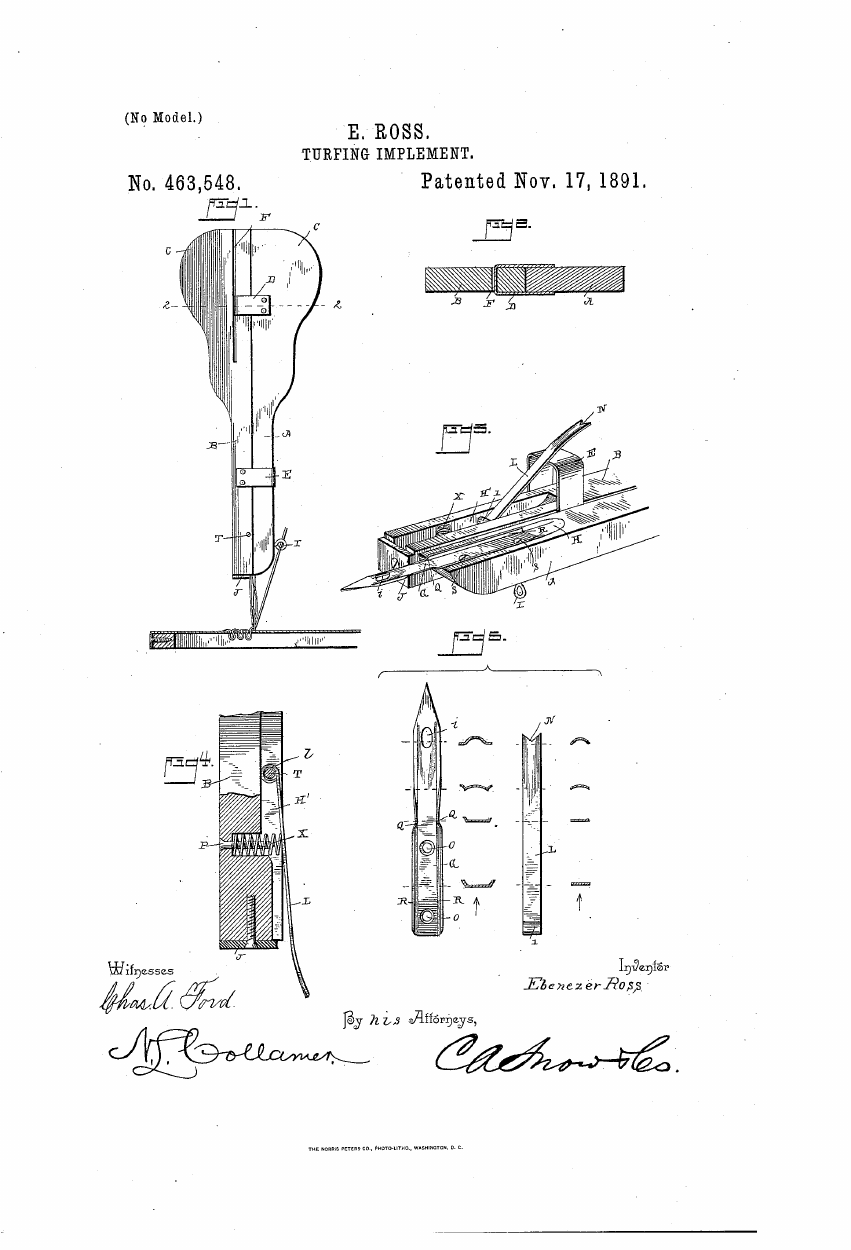
Ross sold patterns as well as tools. The Winterthur Library holds his firm’s catalogue of rug patterns, E. Ross & Co., Toledo, 1891. Most of its patterns were carried over from earlier catalogues, but two of them were his own, “Mastiff Dog” and “Lion and Palm”, which Montgomery Ward and Sears later copied.55“[Catalog of rug patterns], E. Ross & Co., Toledo, Ohio, 1891”, 1891, Winterthur Library. Record A hooked rug made in Toledo between 1890 and 1900 from the “Lion and Palm” pattern is at the Art Institute of Chicago.66Lion with Palms Rug, after a pattern by Ebenezer Ross, 1890–1900, Art Institute of Chicago, 71710. Record A Christie’s lot note also credits Ross with a mechanical punch hook in 1886.77“Ebenezer Ross of Toledo: a mechanical punch hook (1886) and mail-order rug patterns”, 1886–1891, research note. Record
Tools of this kind travelled. The Auckland War Memorial Museum holds a “Semi-automated ‘Jewel’ rug-hooking tool for punching pile through backing”, painted “Jewel Pat. Allowed”, which its record says was patented in the United States in 1886. The donor picked it up in Auckland in 1930.88““Jewel” rug-hooking tool, patented 1886 (Auckland Museum 1932.212.1)”, by 1930 (patent 1886, per the museum's record), Auckland War Memorial Museum (via Wikimedia Commons), 1932.212.1. Record
Ross’s patent expired in 1908.99Ebenezer Ross, “Turfing Implement” (US463548A), patented 17 Nov 1891. Record In August of that year Samuel Henry Perrier of Troy, Oregon, was granted a patent for a “Turfing Needle”, for “tufted or pile work in embroidery and rug making”.1010Samuel Henry Perrier, “Turfing Needle” (US897200A), filed 17 Oct 1907, granted 25 Aug 1908. Record
Needles for the home
The Susan Burr is one of the tools that followed. Its record dates it to the 1920s or 1930s, and a comparable machine at the Greer Heritage Museum (acc. 2002.1.1&2) is dated to the 1920s.1111“Ye ‘Susan Burr’ Hooked Rug Machine”, c. 1920s–1930s, Tuft the World (own collection). Record “Greer Heritage Museum holds a comparable Susan Burr machine (acc. 2002.1.1&2)”, research note. Record
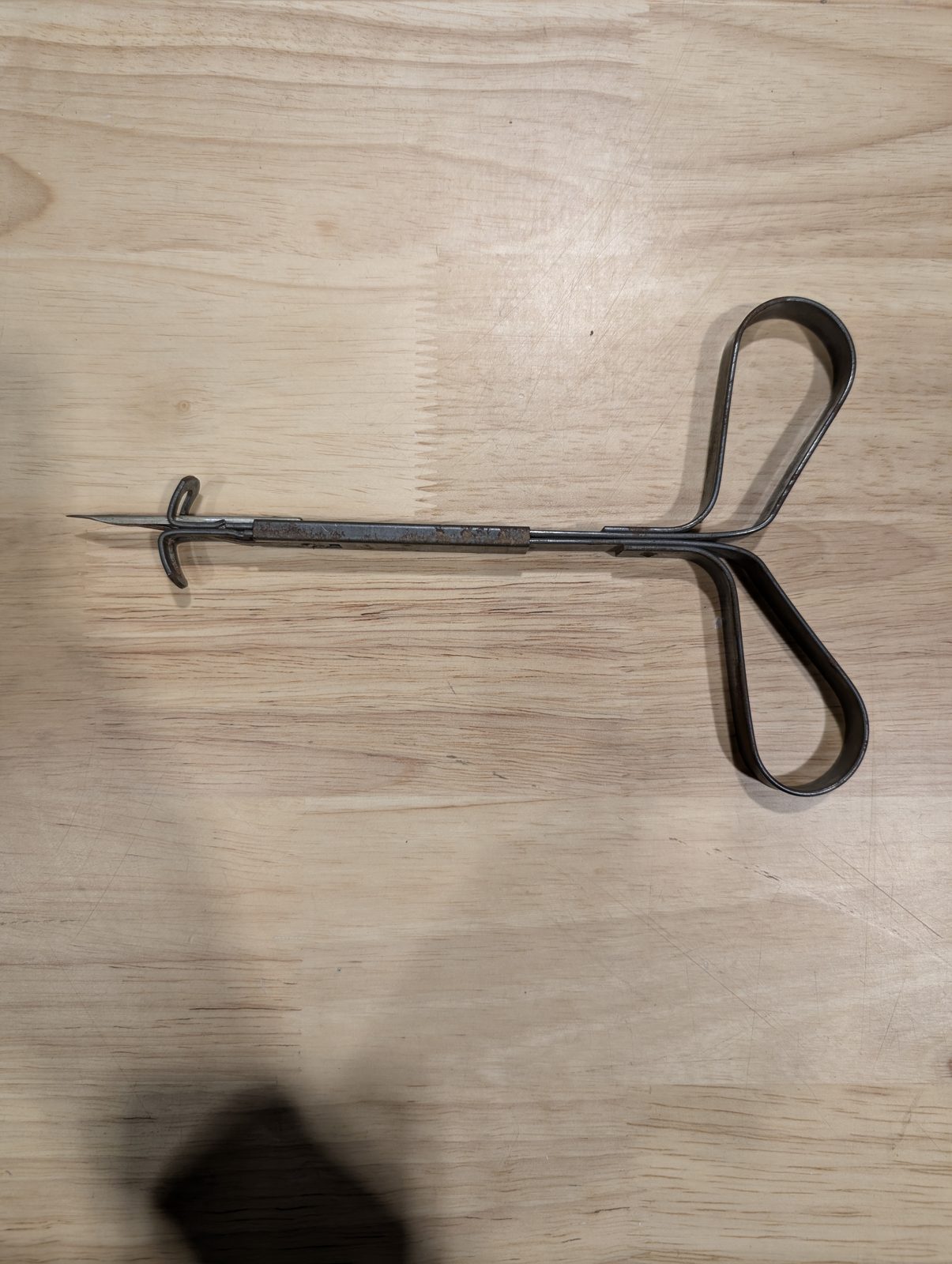
A second tool in the same collection, the All Steel Shuttle Needle of the Molter-Reinhard Co. of Chicago, is made wholly of steel. One handle carries the needle point and the other a “blue steel looper”, and the printed directions describe the same alternation: “insert needle point as far as it will go, then insert looper (which is the other handle)”. The firm sold yarn and patterns too, as Ross had done (“You will be pleased with our rug patterns”). The package is undated.1212“All Steel Shuttle Needle”, undated (probably 1920s–1930s), Tuft the World (own collection). Record
Other inventors patented hand tools of their own. John E. Garrett of New Glasgow, Nova Scotia, patented a “Rug Hooker” in 1926 and a second in 1933; the first is very likely the Bluenose Rug Hooker.1313John E. Garrett, “Rug Hooker” (US1605711A), filed 1 Feb 1926, granted 2 Nov 1926. Record John E. Garrett, “Rug Hooker” (US1941346A), filed 11 Apr 1933, granted 26 Dec 1933. Record A Bucilla catalogue photographed at the Winterthur Library sold the Bluenose as “the fastest rug making innovation procurable today”.1414“Bucilla rug materials catalog page: Bluenose Rug Hooker and tools”, Winterthur Library. Record E. J. Gearhart filed for a “Semiautomatic Turfing Device” in 1931, a spring-loaded punch needle by a later patent’s account.1515E. J. Gearhart, “Semiautomatic Turfing Device” (US1912977A), filed 11 Aug 1931, granted 6 Jun 1933. Record John S. Doyel, “Rug-tufting device suitable for home use by hobyists” (US3968757A), filed 31 Oct 1975, granted 13 July 1976. Record Foster K. Solliday of Grand Rapids, Michigan, filed for a “Hooked Rug Making Device” in 1935.1616Foster K. Solliday, “Hooked Rug Making Device” (US2077719A), filed 27 May 1935, granted 20 Apr 1937. Record
A motor, then air, then a trigger
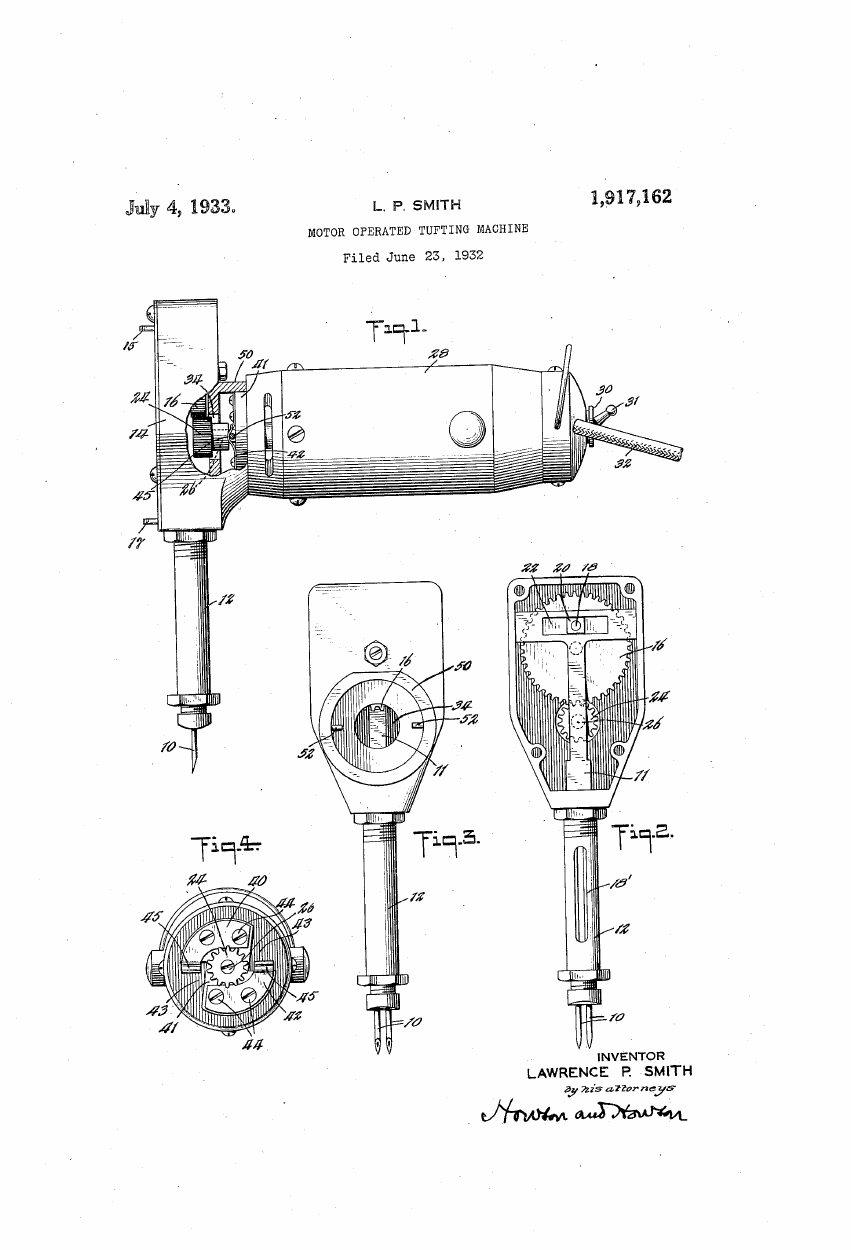
The tufting machine, meanwhile, started from the sewing machine rather than the hand tool (chapter 5). In 1922 August J. Carter of Chattanooga filed for a “Tufting-Attachment Mechanism for Sewing Machines”.1717“Carter Brothers, Chattanooga, 1922: first patent claiming needle + loop former + separate cutting knife”, 1922, research note. Record Ten years later a hand tool with its own motor was patented in Dalton. Lawrence P. Smith of Dalton filed for a “Motor Operated Tufting Machine” on 23 June 1932, assigned to Cabin Crafts and granted on 4 July 1933: a handheld tool with the motor in its body and the needle below, the earliest motorised hand tufting tool found in this research.1818Lawrence P. Smith, “Motor Operated Tufting Machine” (US1917162A), filed 23 Jun 1932, granted 4 Jul 1933. Record
Air came after the war, in two patents filed in June and July 1946. Samuel P. Parker’s “Tufting Device”, assigned to Callaway Mills of LaGrange, Georgia, was an air-fed handheld tool.1919Samuel P. Parker, “Tufting Device” (US2422126A), filed 9 Jul 1946, granted 10 Jun 1947. Record James H. Shay’s “Hooked Rug Machine”, assigned to Shaycraft Inc. of Newtown Square, Pennsylvania, drove a hand rug tool with compressed-air pistons, and it cites Ross’s patent of 1891.2020James H. Shay, “Hooked Rug Machine” (US2442906A), filed 11 Jun 1946, granted 8 Jun 1948. Record
Next came a hand tool for cut pile. Melvin S. Hurley of Bridgend, England, filed in the United States in 1949 for a “Hand Tool for Making Rugs, Carpets and the Like with a Cut Pile”, and a British patent of his for the same tool, so far seen only through search summaries, was published in 1951.2121Melvin S. Hurley, “Hand Tool for Making Rugs, Carpets and the Like with a Cut Pile” (US2605727A), filed 7 Dec 1949, granted 5 Aug 1952. Record Melvin Sivyer Hurley, “A new or improved hand tool for making rugs, carpets and the like with a cut pile” (GB663196A), priority 10 Dec 1948; published 19 Dec 1951. Record In October 1952 Hans G. Lustig of Lake Placid, New York, filed for a “Carpet Forming Device”, a handheld tool with a trigger and a removable knife.2222Hans G. Lustig, “Carpet Forming Device” (US2753820A), filed 10 Oct 1952, granted 10 Jul 1956. Record
The “tufting gun” gets its name
Through the 1950s hand tools of this kind were patented as tufting machines or implements: by Theron F. Gifford of Chattanooga for the Ten-Tex Corp. (filed 1953), by Russell L. Sterner of Downey, California (1955), and by M. L. Ward and Lewis Teal for Callaway Mills (1956).2323Theron F. Gifford, “Portable Tufting Machine” (US2837045A), filed 6 Nov 1953, granted 3 Jun 1958. Record Russell L. Sterner, “Tufting Machine” (US2887076A), filed 14 Feb 1955, granted 19 May 1959. Record M. L. Ward, “Tufting Implement for Producing High and Low Pile” (US2879731A), filed 24 Oct 1956, granted 31 Mar 1959. Record Cabin Crafts came back in 1962 with Charles D. Elliott’s “Portable Machine for Tufting Cut Pile”, “Hand carried and hand guided”,2424Charles D. Elliott, “Portable Machine for Tufting Cut Pile” (US3144844A), filed 11 Oct 1962, granted 18 Aug 1964. Record and Bigelow-Sanford was assigned O. J. Roberts’s “Portable Tufting Machine”, filed in 1964.2525O. J. Roberts et al., “Portable Tufting Machine” (US3229653A), filed 15 Jan 1964, granted 18 Jan 1966. Record
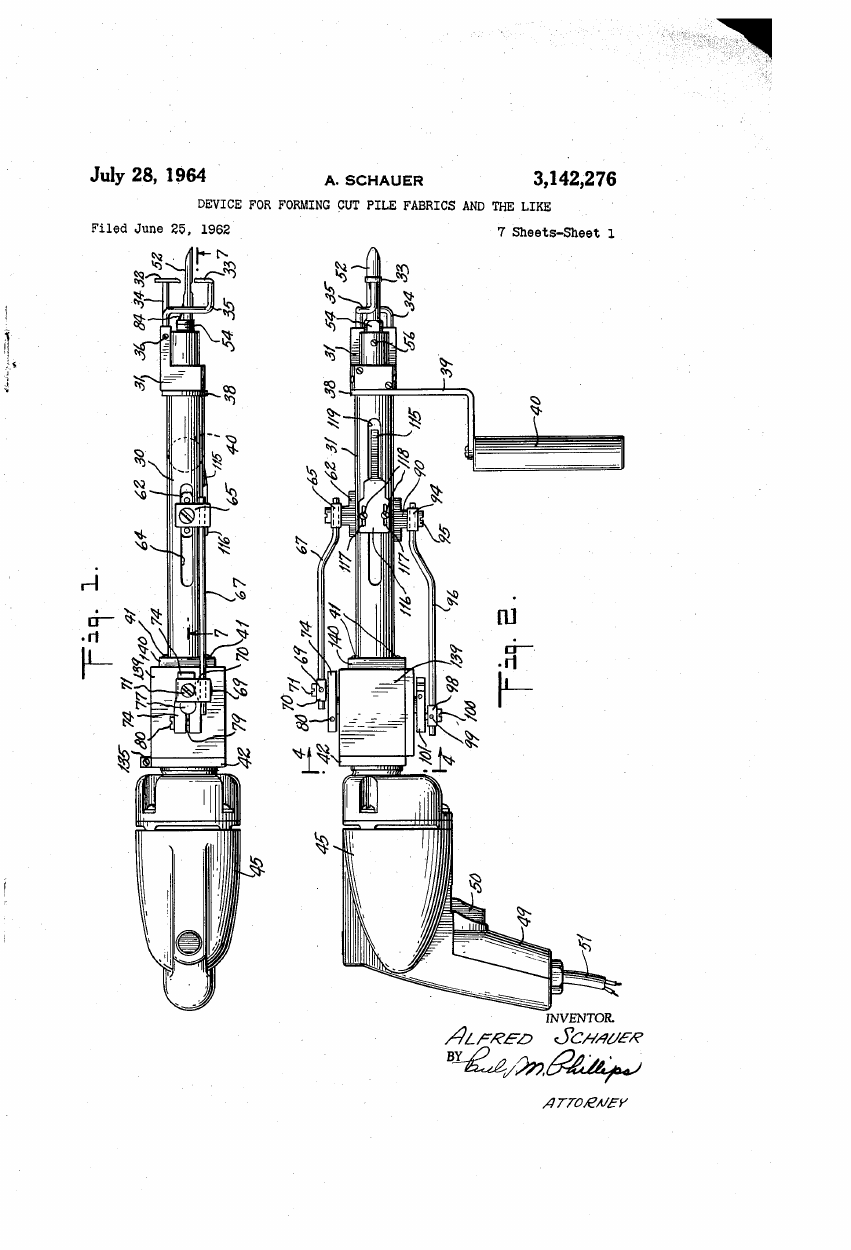
The word “gun” appears in the patent of Alfred Schauer of Elmhurst, New York, filed on 25 June 1962 and granted in 1964. Schauer called his tool a “hand gun-type device”, used the phrase “tufting gun”, and said that such hand guns “have been used for some time”. It is the earliest use of the term found so far, and Schauer’s remark places the guns themselves earlier still.2626Alfred Schauer, “Device for Forming Cut Pile Fabrics and the Like” (US3142276A), filed 25 Jun 1962, granted 28 Jul 1964. Record “‘Tufting gun’ in print: patents of 1964 and 1968”, 1964–1968, research note. Record Helmut C. Mueller’s patent for Bigelow-Sanford, filed in 1965, speaks of a “handheld tufting gun”.2727Helmut C. Mueller, “Method and Apparatus for Cutting Pile Yarns” (US3389667A), filed 23 Dec 1965, granted 25 Jun 1968. Record “‘Tufting gun’ in print: patents of 1964 and 1968”, 1964–1968, research note. Record
Who used these guns, and for what, is less clear. Several of the patents went to companies, among them Cabin Crafts, Callaway Mills, Ten-Tex and Bigelow-Sanford. The custom studios (chapter 11) made claims of their own: trade sources say Stanislav V’Soske, whose workshop was in Grand Rapids, Michigan, developed “the modern hand-tufting technique” in 1924,2828“V’Soske”, workshop c. 1920 (Grand Rapids); hand-tufting dated 1924, V'Soske. Record and Edward Fields of New York says its founder developed a hand-tufting tool, the “Magic Needle”, in the mid-1930s.2929“Edward Fields”, founded 1935, Edward Fields. Record Neither claim has yet been matched to a patent or a dated tool.
One use is named in a patent. In 1990 William H. Satterfield filed for a “Hand-held Tufting Mending Gun”, a Dalton patent assigned to Spencer Wright Industries. Its list of prior art cites the hand guns of Lustig, Gifford, Ward, Sterner, Schauer, Elliott and Roberts.3030William H. Satterfield, “Hand-held Tufting Mending Gun” (US5090341A), filed 18 Sep 1990, granted 25 Feb 1992. Record Shaw Industries’ design team has told Tim Eads, in conversation, that hand-held guns are still used on the broadloom line to fix mistakes found at final inspection; a written source for this is still to be found.3131“Hand tufting guns are still used to mend broadloom at final inspection”, 2026 (conversation), Shaw Industries (design team, in conversation). Record
Allersberg: the pneumatic gun
Europe had its own hand devices: a Danish “Apparatus for Hand Sewing Carpets” of 1938, known so far only through search summaries, has family members in five other countries, though whether its “sewing” means making pile is still to be confirmed.3232Ernst Thomsen Christian, “Apparatus for Hand Sewing Carpets” (CH214147A), Danish priority 4 Oct 1938; published 15 Apr 1941. Record In Germany a company grew up around the hand-tufting gun. According to the history page of Hofmann Handtuft-Technik GmbH, now in Nördlingen, trials with the hand-tuft technique began in 1969, and Scholz Handtuft-Technik KG was founded in Allersberg near Nuremberg in 1973, with Hartmut Scholz and Heinz Hofmann as managing directors. Scholz left in 1979, and the firm took Hofmann’s name. Company catalogue material dates the first machines to 1973 and their market launch to 1975.3333“Hofmann Handtuft-Technik GmbH”, trials 1969; founded 1973 as Scholz Handtuft-Technik KG; GmbH in Nördlingen 1992, Hofmann Handtuft-Technik GmbH. Record
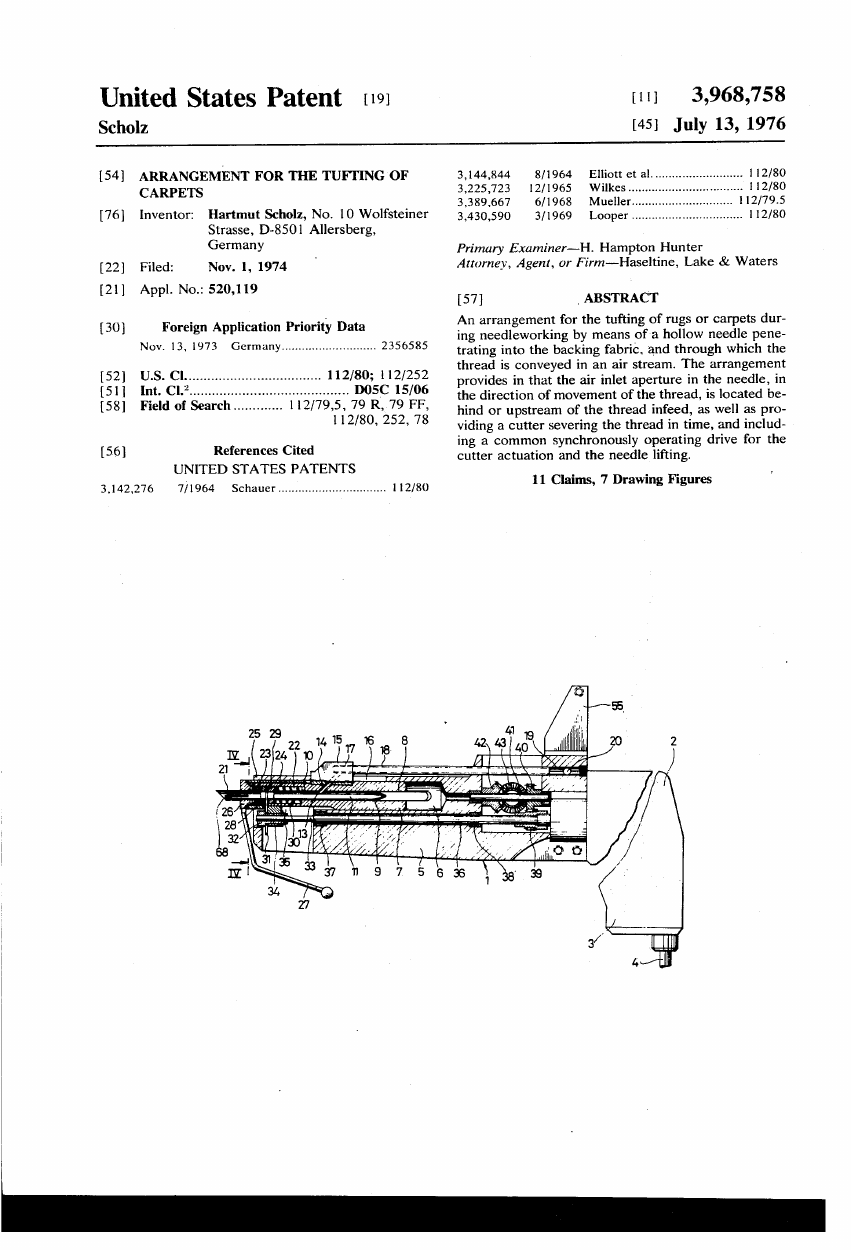
Scholz filed in Germany for a “Device for tufting carpets by hand” on 13 November 1973.3434Hartmut Scholz, “Device for tufting carpets by hand” (DE2356585C2), priority 13 Nov 1973; Auslegeschrift (B1) 28 Nov 1974; C2 published 17 Jul 1975. Record Its American counterpart, granted on 13 July 1976, describes a pneumatic hand gun: a hollow needle pierces the backing, the yarn is carried through it in an air stream, and one synchronous drive works both the cutter and the needle lift. It cites the American hand-gun patents of Schauer, Elliott and Mueller.3535Hartmut Scholz, “Arrangement for the Tufting of Carpets” (US3968758A), filed 1 Nov 1974; patented 13 Jul 1976 (German priority 13 Nov 1973, DE 2356585). Record
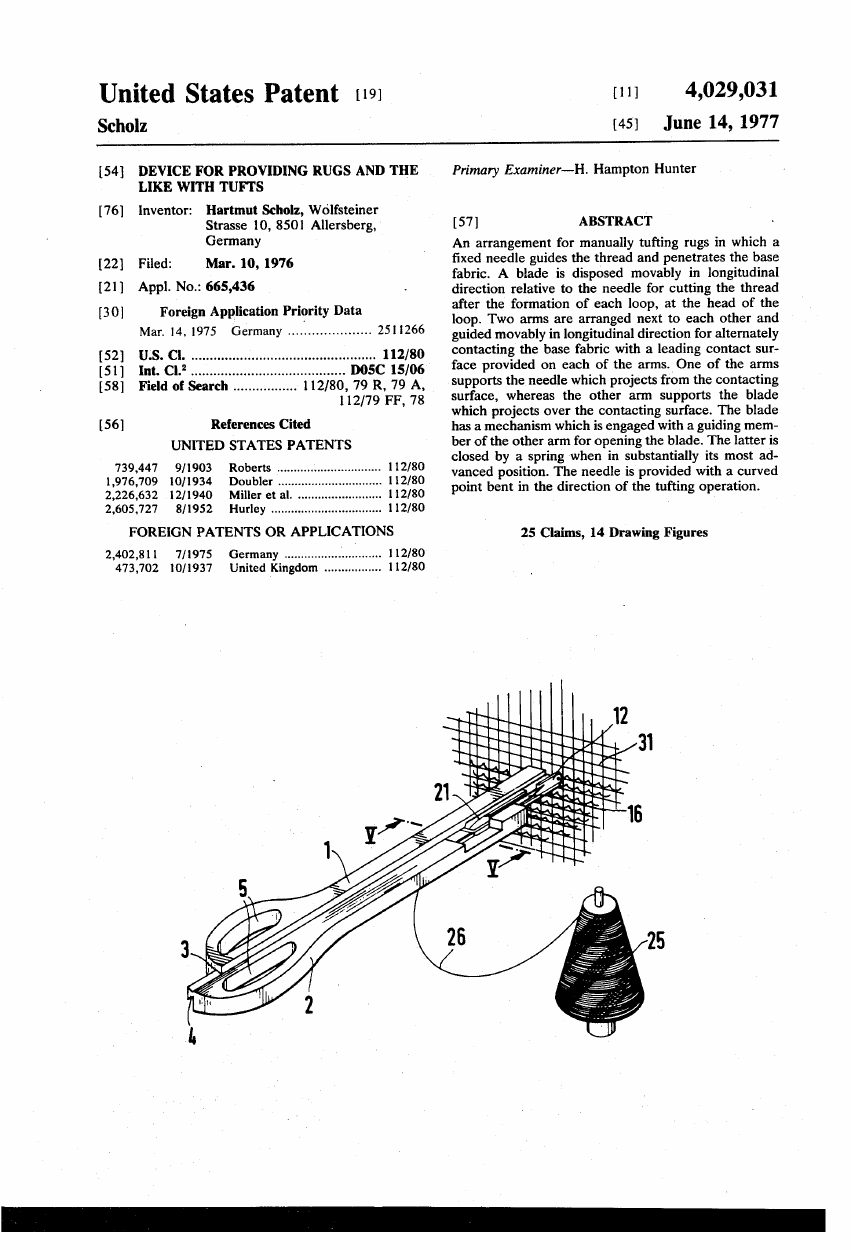
Scholz’s second patent family, with a German priority of 14 March 1975, went back to the hand tool. Its American member, granted in 1977, is a manual device with two arms worked alternately against the backing. One arm carries a fixed needle that guides the yarn; the other carries a blade that slides along the needle and cuts the yarn after each loop, closed by a spring. It cites Hurley’s cut-pile hand tool.3636Hartmut Scholz, “Device for Providing Rugs and the Like with Tufts” (US4029031A), filed 10 Mar 1976; patented 14 Jun 1977 (German priority 14 Mar 1975, DE 2511266). Record This is Ross’s two-part, alternate-stroke action with a blade added.
A second German gun is linked to Hans Hartleb, whose “hand tufting device” patent of 1978 has so far been seen only through search summaries.3737Hans Hartleb, “Tufting device, in particular hand tufting device” (DE2815801A1), priority 12 Apr 1978; published 18 Oct 1979. Record An Australian firm’s patent, filed in 2008, describes “a traditional hand tufting gun for instance, Hofmann™ or Hartleb™, each of which are limited to tufting along an outline at a constant pile height”. Its own aim, to put the gun on a computer-guided machine, belongs to chapter 12.3838Wilcom Pty Ltd, “An improved tufting machine” (EP2077348B1), AU priority 4 Jan 2008 (AU2008900045); B1 granted 31 Aug 2011. Record
Hong Kong, and the tools that stayed by hand
By a Hong Kong account, a gun was also being motorised there in 1973, the year Scholz filed. Tai Ping Carpets, founded in 1956, had moved from hand-knotting to hand-tufting, by its own account.3939“Tai Ping Carpets”, founded 1956, Tai Ping Carpets. Record Its general manager, the engineer Yip Yuen-cheung (Anthony Yeh), developed a new cut-pile tufting needle, drawing, says the Hong Kong Heritage Project’s Chinese text, on the American method of making carpet with a single-needle sewing machine and on household tufting tools (家用簇絨工具).4040“Tai Ping’s tufting tool drew on both the American machine and domestic hand-tufting tools”, research note. Record The same source says that in 1973 Tai Ping fitted its tufting gun with a motor and made it lighter.4141“1973: Tai Ping motorises the tufting gun”, 1973, research note. Record The dates conflict. A 2021 trade article credits Yeh with a pneumatic gun in 1960, and Hong Kong heritage articles call the 1973 gun “the world’s first” (全球首枝), a claim the American patents above contradict.4242“1973: Tai Ping motorises the tufting gun”, 1973, research note. Record “CONFLICT: when was the tufting gun invented?”, research note. Record
In mainland China (chapter 8) a utility model for “A hand-held horizontal electric weaving needle for weaving carpets” was filed in April 2004, and a second, filed that November, describes an electric gun with a small motor, a gear-transmission box and a connecting rod.4343“A hand-held horizontal electric weaving needle for weaving carpets” (CN2723478Y), filed 19 Apr 2004 (application 200420044858.X); granted/published 7 Sep 2005. Record “A hand-held high-speed electric weaving needle for weaving carpets” (CN2806530Y), filed 23 Nov 2004. Record
The unpowered tool never disappeared. Manual speed-tufting tools with the same two-part alternating action are sold new in Mirzapur, India, though commercial pile work uses 220-volt electric guns.4444“Manual speed-tufting tools are still sold new in Mirzapur, India”, research note. Record Nor did the home tool. On 13 July 1976 the patent for Scholz’s pneumatic gun was granted as US 3,968,758; the number before it went the same day to John S. Doyel’s “Rug-tufting device suitable for home use by hobyists”, a hand-operated tool “made primarily of molded plastic components”.4545Hartmut Scholz, “Arrangement for the Tufting of Carpets” (US3968758A), filed 1 Nov 1974; patented 13 Jul 1976 (German priority 13 Nov 1973, DE 2356585). Record John S. Doyel, “Rug-tufting device suitable for home use by hobyists” (US3968757A), filed 31 Oct 1975, granted 13 July 1976. Record Doyel’s patent is very likely the one behind Ronco’s 1975 “Speed-Tufting Kit”, sold on television.4646“Ronco ‘Speed-Tufting Kit’ (#1500), 1975”, © 1975, Tuft the World (own collection), Ronco #1500. Record That kit, and the home tool’s later return, belong to chapter 13.
This chapter argues that the tufting gun has no single inventor. It grew out of hand tools like Ross’s, a needle with a second part to hold or cut the loop. In the patents found so far, American hand tools gained a motor in 1932, air in 1946, a trigger in 1952 and the name “tufting gun” by 1962; in the 1970s Scholz in Germany patented an air-fed gun on the principle of today’s professional guns, and Tai Ping in Hong Kong, by the Hong Kong Heritage Project’s account, fitted its gun with a motor.
Notes
- 1The Holley Associates. Ye “Susan Burr” Hooked Rug Machine, c. 1920s–1930s. Tuft the World (own collection). docs.google.com/spreadsheets/d/1cj3lVGl_GaLrJt1FuzGKVGMVO3G6xLL3V6MIDF-iERM/edit. Record
- 2The Holley Associates. Ye “Susan Burr” Hooked Rug Machine, c. 1920s–1930s. Tuft the World (own collection). docs.google.com/spreadsheets/d/1cj3lVGl_GaLrJt1FuzGKVGMVO3G6xLL3V6MIDF-iERM/edit. Record
- 3Ebenezer Ross, “Turfing Implement” (US463548A), patented 17 Nov 1891. patents.google.com/patent/US463548A/en. Record Ebenezer Ross, “Embroidery Machine” (US251381A), filed 1881, granted 27 Dec 1881. patents.google.com/patent/US251381A/en. Record
- 4Ebenezer Ross, “Turfing Implement” (US463548A), patented 17 Nov 1891. patents.google.com/patent/US463548A/en. Record
- 5E. Ross & Co. “[Catalog of rug patterns], E. Ross & Co., Toledo, Ohio, 1891,” 1891. Winterthur Library. archive.org/details/catalogofrugpatt00eros. Record
- 6Unknown maker. Lion with Palms Rug, after a pattern by Ebenezer Ross, 1890–1900. Art Institute of Chicago, 71710. artic.edu/artworks/71710/lion-with-palms-rug. Record
- 7“Ebenezer Ross of Toledo: a mechanical punch hook (1886) and mail-order rug patterns.” Research note. christies.com.cn/lot/lot-1709610. Record
- 8““Jewel” rug-hooking tool, patented 1886 (Auckland Museum 1932.212.1),” by 1930 (patent 1886, per the museum's record). 1932.212.1, Auckland War Memorial Museum (via Wikimedia Commons). commons.wikimedia.org/wiki/File:Tool,_rug-hooking_(AM_1932.212-1).jpg. Record
- 9Ebenezer Ross, “Turfing Implement” (US463548A), patented 17 Nov 1891. patents.google.com/patent/US463548A/en. Record
- 10Samuel Henry Perrier, “Turfing Needle” (US897200A), filed 17 Oct 1907, granted 25 Aug 1908. patents.google.com/patent/US897200A/en. Record
- 11The Holley Associates. Ye “Susan Burr” Hooked Rug Machine, c. 1920s–1930s. Tuft the World (own collection). docs.google.com/spreadsheets/d/1cj3lVGl_GaLrJt1FuzGKVGMVO3G6xLL3V6MIDF-iERM/edit. Record “Greer Heritage Museum holds a comparable Susan Burr machine (acc. 2002.1.1&2).” Research note, TTW Script Bank fact-check notes (Claude research, Aug 2026). Record
- 12Molter-Reinhard Co., Inc. All Steel Shuttle Needle, undated (probably 1920s–1930s). Tuft the World (own collection). Record
- 13John E. Garrett, “Rug Hooker” (US1605711A), filed 1 Feb 1926, granted 2 Nov 1926. patents.google.com/patent/US1605711A/en. Record John E. Garrett, “Rug Hooker” (US1941346A), filed 11 Apr 1933, granted 26 Dec 1933. patents.google.com/patent/US1941346A/en. Record
- 14“Bucilla rug materials catalog page: Bluenose Rug Hooker and tools,” n.d. Winterthur Library. drive.google.com/file/d/12T-GDkDIbkotAMbExH7aS_Lk6B9fQDTo/view. Record
- 15E. J. Gearhart, “Semiautomatic Turfing Device” (US1912977A), filed 11 Aug 1931, granted 6 Jun 1933. patents.google.com/patent/US1912977A/en. Record John S. Doyel, “Rug-tufting device suitable for home use by hobyists” (US3968757A), filed 31 Oct 1975, granted 13 July 1976. patents.google.com/patent/US3968757A/en. Record
- 16Foster K. Solliday, “Hooked Rug Making Device” (US2077719A), filed 27 May 1935, granted 20 Apr 1937. patents.google.com/patent/US2077719A/en. Record
- 17“Carter Brothers, Chattanooga, 1922: first patent claiming needle + loop former + separate cutting knife.” Research note, TTW Script Bank fact-check notes (Claude research, Aug 2026). Record
- 18Lawrence P. Smith, “Motor Operated Tufting Machine” (US1917162A), filed 23 Jun 1932, granted 4 Jul 1933; assigned to Cabin Crafts. patents.google.com/patent/US1917162A/en. Record
- 19Samuel P. Parker, “Tufting Device” (US2422126A), filed 9 Jul 1946, granted 10 Jun 1947; assigned to Callaway Mills. patents.google.com/patent/US2422126A/en. Record
- 20James H. Shay, “Hooked Rug Machine” (US2442906A), filed 11 Jun 1946, granted 8 Jun 1948; assigned to Shaycraft Inc. patents.google.com/patent/US2442906A/en. Record
- 21Melvin S. Hurley, “Hand Tool for Making Rugs, Carpets and the Like with a Cut Pile” (US2605727A), filed 7 Dec 1949, granted 5 Aug 1952. patents.google.com/patent/US2605727A/en. Record Melvin Sivyer Hurley, “A new or improved hand tool for making rugs, carpets and the like with a cut pile” (GB663196A), priority 10 Dec 1948; published 19 Dec 1951. patents.google.com/patent/GB663196A/en. Record
- 22Hans G. Lustig, “Carpet Forming Device” (US2753820A), filed 10 Oct 1952, granted 10 Jul 1956. patents.google.com/patent/US2753820A/en. Record
- 23Theron F. Gifford, “Portable Tufting Machine” (US2837045A), filed 6 Nov 1953, granted 3 Jun 1958; assigned to Ten-Tex Corp. patents.google.com/patent/US2837045A/en. Record Russell L. Sterner, “Tufting Machine” (US2887076A), filed 14 Feb 1955, granted 19 May 1959; assigned to Clarence Klug. patents.google.com/patent/US2887076A/en. Record M. L. Ward, “Tufting Implement for Producing High and Low Pile” (US2879731A), filed 24 Oct 1956, granted 31 Mar 1959; assigned to Callaway Mills. patents.google.com/patent/US2879731A/en. Record
- 24Charles D. Elliott, “Portable Machine for Tufting Cut Pile” (US3144844A), filed 11 Oct 1962, granted 18 Aug 1964; assigned to Cabin Crafts. patents.google.com/patent/US3144844A/en. Record
- 25O. J. Roberts et al., “Portable Tufting Machine” (US3229653A), filed 15 Jan 1964, granted 18 Jan 1966; assigned to Bigelow-Sanford. patents.google.com/patent/US3229653A/en. Record
- 26Alfred Schauer, “Device for Forming Cut Pile Fabrics and the Like” (US3142276A), filed 25 Jun 1962, granted 28 Jul 1964. patents.google.com/patent/US3142276A/en. Record “‘Tufting gun’ in print: patents of 1964 and 1968.” Research note. Record
- 27Helmut C. Mueller, “Method and Apparatus for Cutting Pile Yarns” (US3389667A), filed 23 Dec 1965, granted 25 Jun 1968; assigned to Bigelow-Sanford. patents.google.com/patent/US3389667A/en. Record “‘Tufting gun’ in print: patents of 1964 and 1968.” Research note. Record
- 28Stanislav V'Soske with his brothers (incl. Thadius) and Vesta V'Soske. “V’Soske,” workshop c. 1920 (Grand Rapids); hand-tufting dated 1924. V'Soske. en.wikipedia.org/wiki/Stanislav_V%27Soske. Record
- 29Edward Fields and his wife. “Edward Fields,” founded 1935. Edward Fields. edwardfields.com/about/heritage. Record
- 30William H. Satterfield, “Hand-held Tufting Mending Gun” (US5090341A), filed 18 Sep 1990, granted 25 Feb 1992; assigned to Spencer Wright Industries. patents.google.com/patent/US5090341A/en. Record
- 31“Hand tufting guns are still used to mend broadloom at final inspection.” Research note. Record
- 32Ernst Thomsen Christian, “Apparatus for Hand Sewing Carpets” (CH214147A), Danish priority 4 Oct 1938; published 15 Apr 1941. patents.google.com/patent/CH214147A/de. Record
- 33Heinz Hofmann and Hartmut Scholz (founders); today Michael Hofmann and Nico Coletta. “Hofmann Handtuft-Technik GmbH,” trials 1969; founded 1973 as Scholz Handtuft-Technik KG; GmbH in Nördlingen 1992. Hofmann Handtuft-Technik GmbH. hofmann-handtuft.de/en/history. Record
- 34Hartmut Scholz, “Device for tufting carpets by hand” (DE2356585C2), priority 13 Nov 1973; Auslegeschrift (B1) 28 Nov 1974; C2 published 17 Jul 1975. patents.google.com/patent/DE2356585C2/de. Record
- 35Hartmut Scholz, “Arrangement for the Tufting of Carpets” (US3968758A), filed 1 Nov 1974; patented 13 Jul 1976 (German priority 13 Nov 1973, DE 2356585). patents.google.com/patent/US3968758A/en. Record
- 36Hartmut Scholz, “Device for Providing Rugs and the Like with Tufts” (US4029031A), filed 10 Mar 1976; patented 14 Jun 1977 (German priority 14 Mar 1975, DE 2511266). patents.google.com/patent/US4029031A/en. Record
- 37Hans Hartleb, “Tufting device, in particular hand tufting device” (DE2815801A1), priority 12 Apr 1978; published 18 Oct 1979. patents.google.com/patent/DE2815801A1/de. Record
- 38Wilcom Pty Ltd, “An improved tufting machine” (EP2077348B1), AU priority 4 Jan 2008 (AU2008900045); B1 granted 31 Aug 2011. patents.google.com/patent/EP2077348B1/en. Record
- 39Sir Lawrence and Sir Horace Kadoorie with partners. “Tai Ping Carpets,” founded 1956. Tai Ping Carpets. taipingcarpets.com/about/heritage. Record
- 40“Tai Ping’s tufting tool drew on both the American machine and domestic hand-tufting tools.” Research note, Tuft the World research brief: The Non-English Record. hongkongheritage.org. Record
- 41“1973: Tai Ping motorises the tufting gun.” Research note, Tuft the World research brief: The Non-English Record. hongkongheritage.org. Record
- 42“1973: Tai Ping motorises the tufting gun.” Research note, Tuft the World research brief: The Non-English Record. hongkongheritage.org. Record “CONFLICT: when was the tufting gun invented?.” Research note. Record
- 43“A hand-held horizontal electric weaving needle for weaving carpets” (CN2723478Y), filed 19 Apr 2004 (application 200420044858.X); granted/published 7 Sep 2005. patents.google.com/patent/CN2723478Y/zh. Record “A hand-held high-speed electric weaving needle for weaving carpets” (CN2806530Y), filed 23 Nov 2004. patents.google.com/patent/CN2806530Y/zh. Record
- 44“Manual speed-tufting tools are still sold new in Mirzapur, India.” Research note, TTW Script Bank fact-check notes (Claude research, Aug 2026). Record
- 45Hartmut Scholz, “Arrangement for the Tufting of Carpets” (US3968758A), filed 1 Nov 1974; patented 13 Jul 1976 (German priority 13 Nov 1973, DE 2356585). patents.google.com/patent/US3968758A/en. Record John S. Doyel, “Rug-tufting device suitable for home use by hobyists” (US3968757A), filed 31 Oct 1975, granted 13 July 1976. patents.google.com/patent/US3968757A/en. Record
- 46Southbury Manufacturing Corp., South Britain, Connecticut (maker); Ronco Teleproducts, Inc., Chicago (distributor). Ronco “Speed-Tufting Kit” (#1500), 1975, © 1975. Tuft the World (own collection), Ronco #1500. Record

Where the sources are
- US patents30
- Research notes, not yet traced to a public source8
- Tuft the World (own collection)3
- Winterthur Library2
- Art Institute of Chicago1
- Auckland War Memorial Museum (via Wikimedia Commons)1
- V'Soske1
- Edward Fields1
- Shaw Industries (design team, in conversation)1
- Hofmann Handtuft-Technik GmbH1
- Tai Ping Carpets1